• English
  • हिन्दी (Hindi)
  • বাংলা (Bengali)
  • தமிழ் (Tamil)
  • తెలుగు (Telugu)
  • मराठी (Marathi)
  • ગુજરાતી (Gujarati)
  • ಕನ್ನಡ (Kannada)
  • മലയാളം (Malayalam)
  • ਪੰਜਾਬੀ (Punjabi)
  • ଓଡ଼ିଆ (Odia)
  • اردو (Urdu)
  • অসমীয়া (Assamese)
  • भोजपुरी (Bhojpuri)
  • मैथिली (Maithili)
  • डोगरी (Dogri)
  • कोंकणी (Konkani)
  • संस्कृत (Sanskrit)
  • سنڌي (Sindhi)
  • नेपाली (Nepali)
  • සිංහල (Sinhala)
  • Español (Spanish)
  • Français (French)
  • Deutsch (German)
  • Italiano (Italian)
  • Português (Portuguese)
  • Русский (Russian)
  • 日本語 (Japanese)
  • 한국어 (Korean)
  • 中文 简体 (Chinese Simplified)
  • 中文 繁體 (Chinese Traditional)
  • العربية (Arabic)
  • עברית (Hebrew)
  • فارسی (Persian)
  • Türkçe (Turkish)
  • Nederlands (Dutch)
  • Svenska (Swedish)
  • Norsk (Norwegian)
  • Dansk (Danish)
  • Suomi (Finnish)
  • Polski (Polish)
  • Čeština (Czech)
  • Slovenčina (Slovak)
  • Slovenščina (Slovenian)
  • Magyar (Hungarian)
  • Română (Romanian)
  • Български (Bulgarian)
  • Українська (Ukrainian)
  • Ελληνικά (Greek)
  • Hrvatski (Croatian)
  • Српски (Serbian)
  • ไทย (Thai)
  • Tiếng Việt (Vietnamese)
  • Bahasa Indonesia (Indonesian)
  • Bahasa Melayu (Malay)
  • Filipino
  • မြန်မာ (Burmese)
  • ខ្មែរ (Khmer)
  • ລາວ (Lao)
  • Монгол (Mongolian)
  • Қазақ (Kazakh)
  • Oʻzbek (Uzbek)
  • Кыргызча (Kyrgyz)
  • Тоҷикӣ (Tajik)
  • Türkmen (Turkmen)
  • Azərbaycan (Azerbaijani)
  • Հայերեն (Armenian)
  • ქართული (Georgian)
  • Беларуская (Belarusian)
  • Lietuvių (Lithuanian)
  • Latviešu (Latvian)
  • Eesti (Estonian)
  • Íslenska (Icelandic)
  • Gaeilge (Irish)
  • Gàidhlig (Scots Gaelic)
  • Cymraeg (Welsh)
  • Euskara (Basque)
  • Català (Catalan)
  • Galego (Galician)
  • Malti (Maltese)
  • Македонски (Macedonian)
  • Bosanski (Bosnian)
  • Shqip (Albanian)
  • Afrikaans
  • Kiswahili (Swahili)
  • አማርኛ (Amharic)
  • Hausa
  • Igbo
  • Yorùbá (Yoruba)
  • isiZulu (Zulu)
  • isiXhosa (Xhosa)
  • Sesotho
  • Sepedi
  • Shona
  • Soomaali (Somali)
  • Kinyarwanda
  • Chichewa
  • ትግርኛ (Tigrinya)
  • Oromoo (Oromo)
  • Xitsonga (Tsonga)
  • Luganda
  • Akan (Twi)
  • Lëtzebuergesch (Luxembourgish)
  • Frysk (Frisian)
  • Corsu (Corsican)
  • Esperanto
  • Latina (Latin)
  • Basa Jawa (Javanese)
  • Basa Sunda (Sundanese)
  • Cebuano
  • ʻŌlelo Hawaiʻi (Hawaiian)
  • Gagana Samoa (Samoan)
  • Te Reo Māori (Maori)
  • Kreyòl Ayisyen (Haitian Creole)
  • Runasimi (Quechua)
  • Aymar Aru (Aymara)
  • Avañeʼẽ (Guarani)
  • Kurdî (Kurdish)
  • کوردیی ناوەندی (Kurdish Sorani)
  • پښتو (Pashto)
  • ئۇيغۇرچە (Uyghur)
  • ދިވެހި (Dhivehi)
  • ייִדיש (Yiddish)
  • Krio
  • Mizo
  • Manipuri (Meiteilon)
  • Eʋegbe (Ewe)
  • Lingála
  • Bamanankan (Bambara)
  • Hmoob (Hmong)
  • Ilokano

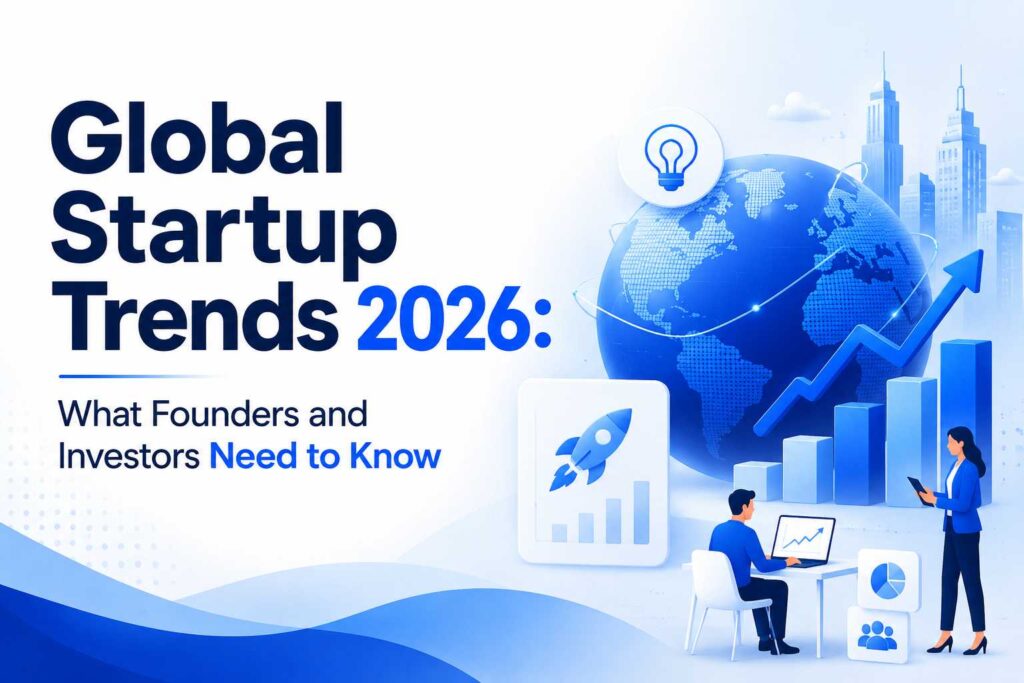
Global Startup Trends 2026: What Founders and Investors Need to Know

The startup world looks very different in mid-2026 than it did just two years ago.

Gagan Saxena

Writer & Blogger

Gagan Saxena

Writer & Blogger

The startup world looks very different in mid-2026 than it did just two years ago. Venture capital is recovering after a long contraction, but it’s flowing into new geographies, new sectors, and new funding structures. For founders, investors, and anyone tracking the startup economy, understanding these global startup trends in 2026 isn’t optional — it’s the difference between riding the wave and missing it entirely.

Here’s a breakdown of the forces reshaping startups worldwide right now, and what they mean for the year ahead.

Global_Startup_Trends_2026

1. AI Has Stopped Being a “Sector” — It’s Now Infrastructure

For years, AI startups competed in their own lane. That’s no longer true. AI has become a general-purpose layer running underneath almost every startup category, from healthcare and legal tech to logistics and finance. Funding data backs this up: AI-native startups have seen funding grow dramatically since 2021, even as overall tech funding contracted over the same stretch, and the value created by AI-first companies has expanded many times faster than non-AI tech businesses.

What’s shifting in 2026 specifically is defensibility. Investors are no longer impressed by a thin wrapper around a large language model. The startups attracting serious capital are the ones building real moats — proprietary data, deep workflow integration, compliance handling, and trusted distribution channels. If your startup’s only differentiator is “we use AI,” that’s not a pitch anymore; it’s the baseline.

2. Venture Capital Is Spreading Far Beyond Silicon Valley

The US still dominates late-stage funding and remains the center of gravity for AI specifically, but the growth story of 2026 is regional diversification. India’s startup ecosystem raised close to $11 billion in 2025 and continues to mature as a viable alternative to the traditional “move to the US” playbook, partly thanks to a strengthening domestic IPO market. The Middle East and North Africa hit a record funding year, and Southeast Asia, Latin America, and Africa are increasingly described as innovation exporters rather than just emerging markets.

That said, this expansion isn’t free of friction. Tightening US visa policies (H-1B, O-1, E-2) have made the traditional US-expansion route harder for early-stage founders, pushing many to scale regionally first and consider US entry only once they have leverage.

3. Funding Is Getting More Creative — Not Just Bigger

One of the clearest shifts in 2026 is that founders increasingly don’t want venture capital alone. With valuations under pressure in some categories, equity has gotten more expensive to raise. As a result, venture debt and revenue-based financing are gaining real traction, particularly among SaaS, e-commerce, and creator-economy startups with predictable income. These structures let founders extend runway or raise against future revenue without taking on the dilution of a full equity round.

At the same time, seed-stage checks for top AI-native startups have ballooned, with some funds writing $20–50 million seed rounds just to lock in promising teams early — a sign of how concentrated enthusiasm still is at the very top of the AI category.

4. Defense Tech Is a Permanent Fixture, Not a Trend

Geopolitical instability has pushed defense and dual-use technology into the mainstream of venture investing. Government initiatives aimed at involving private capital in military procurement, combined with sustained investor appetite, have made defense tech one of the steadier bets in an otherwise unpredictable funding environment. Cybersecurity and “tech sovereignty” plays — especially in Europe — are part of the same pattern, with sovereignty-focused startups in security and specialized AI models becoming a defining theme of the European startup scene this year.

It’s worth noting the obvious caveat: this trend is being driven by real conflict and instability, and in regions directly affected, the near-term effect on local startup ecosystems has been disruptive rather than purely beneficial — funding activity in parts of the Middle East has slowed sharply as investors pause to assess risk.

5. Sustainability Has Moved From Compliance Cost to Business Driver

Climate and sustainability-focused startups are no longer pitching “doing good” as a separate value proposition. The successful ones in 2026 frame measurable environmental impact — energy efficiency, supply chain visibility, circular materials — as a direct line to better margins. This shift is reflected in investor sentiment: a large majority of institutional investors now view sustainability as a long-term value driver rather than simply a regulatory box to check. For climate tech founders, the lesson is clear — lead with ROI and operational resilience, not mission statements alone.

6. Europe’s Hardware and Industrial Comeback

After a decade dominated by software, Europe is seeing a resurgence in physical industry: robotics, space tech, and advanced manufacturing are pulling real investment again. This “industrial rebirth” is closely tied to the broader sovereignty trend, as governments and investors push to reduce dependence on foreign hardware and critical infrastructure. Vertical AI — AI built for highly specific industry use cases rather than general-purpose tools — is the connective tissue across most of this growth.

7. Leaner Teams, AI-Powered Operations

Across nearly every region and sector, startups are running leaner than before. Hybrid work, global contractor hiring, and AI-powered internal tools are letting small teams do work that used to require much larger headcounts. This isn’t just a cost-saving measure — it’s increasingly seen as a competitive advantage, since lean, AI-fluent teams can iterate and validate ideas faster than bulkier competitors.

What This Means for Founders in 2026

A few practical takeaways stand out for anyone building or investing right now:

  • Build defensibility, not demos. Workflow depth and proprietary data matter more than which model you’re using.
  • Think beyond equity. Venture debt and revenue-based financing are legitimate tools if your startup has predictable income.
  • Don’t default to Silicon Valley. Regional ecosystems in India, the Nordics, MENA, and Southeast Asia are increasingly viable starting points.
  • Validate before you build. Testing buying intent — pre-sales, pilots, real workflow shadowing — matters more than user interest surveys.
  • If you’re in climate tech, lead with numbers. Margins, compliance value, and operational savings convert better than mission-driven messaging alone.

Final Thoughts

2026 isn’t a year of one single dominant trend — it’s a year of consolidation around AI as infrastructure, geographic diversification of capital, and a more pragmatic approach to funding and growth. Founders who treat these shifts as operational reality, rather than buzzwords for a pitch deck, will be the ones positioned to scale through the next funding cycle.

Previous Post
Next Post

Leave a Reply

Your email address will not be published. Required fields are marked *

Previous Post
Next Post

Subscribe to Our Newsletter

    © 2026 FindBrief. All Rights Reserved.

    Which language are you reading?

    Apni pasandida bhasha chunein

    • English
    • हिन्दी (Hindi)
    • বাংলা (Bengali)
    • தமிழ் (Tamil)
    • తెలుగు (Telugu)
    • मराठी (Marathi)
    • ગુજરાતી (Gujarati)
    • ಕನ್ನಡ (Kannada)
    • മലയാളം (Malayalam)
    • ਪੰਜਾਬੀ (Punjabi)
    • ଓଡ଼ିଆ (Odia)
    • اردو (Urdu)
    • অসমীয়া (Assamese)
    • भोजपुरी (Bhojpuri)
    • मैथिली (Maithili)
    • डोगरी (Dogri)
    • कोंकणी (Konkani)
    • संस्कृत (Sanskrit)
    • سنڌي (Sindhi)
    • नेपाली (Nepali)
    • සිංහල (Sinhala)
    • Español (Spanish)
    • Français (French)
    • Deutsch (German)
    • Italiano (Italian)
    • Português (Portuguese)
    • Русский (Russian)
    • 日本語 (Japanese)
    • 한국어 (Korean)
    • 中文 简体 (Chinese Simplified)
    • 中文 繁體 (Chinese Traditional)
    • العربية (Arabic)
    • עברית (Hebrew)
    • فارسی (Persian)
    • Türkçe (Turkish)
    • Nederlands (Dutch)
    • Svenska (Swedish)
    • Norsk (Norwegian)
    • Dansk (Danish)
    • Suomi (Finnish)
    • Polski (Polish)
    • Čeština (Czech)
    • Slovenčina (Slovak)
    • Slovenščina (Slovenian)
    • Magyar (Hungarian)
    • Română (Romanian)
    • Български (Bulgarian)
    • Українська (Ukrainian)
    • Ελληνικά (Greek)
    • Hrvatski (Croatian)
    • Српски (Serbian)
    • ไทย (Thai)
    • Tiếng Việt (Vietnamese)
    • Bahasa Indonesia (Indonesian)
    • Bahasa Melayu (Malay)
    • Filipino
    • မြန်မာ (Burmese)
    • ខ្មែរ (Khmer)
    • ລາວ (Lao)
    • Монгол (Mongolian)
    • Қазақ (Kazakh)
    • Oʻzbek (Uzbek)
    • Кыргызча (Kyrgyz)
    • Тоҷикӣ (Tajik)
    • Türkmen (Turkmen)
    • Azərbaycan (Azerbaijani)
    • Հայերեն (Armenian)
    • ქართული (Georgian)
    • Беларуская (Belarusian)
    • Lietuvių (Lithuanian)
    • Latviešu (Latvian)
    • Eesti (Estonian)
    • Íslenska (Icelandic)
    • Gaeilge (Irish)
    • Gàidhlig (Scots Gaelic)
    • Cymraeg (Welsh)
    • Euskara (Basque)
    • Català (Catalan)
    • Galego (Galician)
    • Malti (Maltese)
    • Македонски (Macedonian)
    • Bosanski (Bosnian)
    • Shqip (Albanian)
    • Afrikaans
    • Kiswahili (Swahili)
    • አማርኛ (Amharic)
    • Hausa
    • Igbo
    • Yorùbá (Yoruba)
    • isiZulu (Zulu)
    • isiXhosa (Xhosa)
    • Sesotho
    • Sepedi
    • Shona
    • Soomaali (Somali)
    • Kinyarwanda
    • Chichewa
    • ትግርኛ (Tigrinya)
    • Oromoo (Oromo)
    • Xitsonga (Tsonga)
    • Luganda
    • Akan (Twi)
    • Lëtzebuergesch (Luxembourgish)
    • Frysk (Frisian)
    • Corsu (Corsican)
    • Esperanto
    • Latina (Latin)
    • Basa Jawa (Javanese)
    • Basa Sunda (Sundanese)
    • Cebuano
    • ʻŌlelo Hawaiʻi (Hawaiian)
    • Gagana Samoa (Samoan)
    • Te Reo Māori (Maori)
    • Kreyòl Ayisyen (Haitian Creole)
    • Runasimi (Quechua)
    • Aymar Aru (Aymara)
    • Avañeʼẽ (Guarani)
    • Kurdî (Kurdish)
    • کوردیی ناوەندی (Kurdish Sorani)
    • پښتو (Pashto)
    • ئۇيغۇرچە (Uyghur)
    • ދިވެހި (Dhivehi)
    • ייִדיש (Yiddish)
    • Krio
    • Mizo
    • Manipuri (Meiteilon)
    • Eʋegbe (Ewe)
    • Lingála
    • Bamanankan (Bambara)
    • Hmoob (Hmong)
    • Ilokano
    Scroll to Top