
• English
  • हिन्दी (Hindi)
  • বাংলা (Bengali)
  • தமிழ் (Tamil)
  • తెలుగు (Telugu)
  • मराठी (Marathi)
  • ગુજરાતી (Gujarati)
  • ಕನ್ನಡ (Kannada)
  • മലയാളം (Malayalam)
  • ਪੰਜਾਬੀ (Punjabi)
  • ଓଡ଼ିଆ (Odia)
  • اردو (Urdu)
  • অসমীয়া (Assamese)
  • भोजपुरी (Bhojpuri)
  • मैथिली (Maithili)
  • डोगरी (Dogri)
  • कोंकणी (Konkani)
  • संस्कृत (Sanskrit)
  • سنڌي (Sindhi)
  • नेपाली (Nepali)
  • සිංහල (Sinhala)
  • Español (Spanish)
  • Français (French)
  • Deutsch (German)
  • Italiano (Italian)
  • Português (Portuguese)
  • Русский (Russian)
  • 日本語 (Japanese)
  • 한국어 (Korean)
  • 中文 简体 (Chinese Simplified)
  • 中文 繁體 (Chinese Traditional)
  • العربية (Arabic)
  • עברית (Hebrew)
  • فارسی (Persian)
  • Türkçe (Turkish)
  • Nederlands (Dutch)
  • Svenska (Swedish)
  • Norsk (Norwegian)
  • Dansk (Danish)
  • Suomi (Finnish)
  • Polski (Polish)
  • Čeština (Czech)
  • Slovenčina (Slovak)
  • Slovenščina (Slovenian)
  • Magyar (Hungarian)
  • Română (Romanian)
  • Български (Bulgarian)
  • Українська (Ukrainian)
  • Ελληνικά (Greek)
  • Hrvatski (Croatian)
  • Српски (Serbian)
  • ไทย (Thai)
  • Tiếng Việt (Vietnamese)
  • Bahasa Indonesia (Indonesian)
  • Bahasa Melayu (Malay)
  • Filipino
  • မြန်မာ (Burmese)
  • ខ្មែរ (Khmer)
  • ລາວ (Lao)
  • Монгол (Mongolian)
  • Қазақ (Kazakh)
  • Oʻzbek (Uzbek)
  • Кыргызча (Kyrgyz)
  • Тоҷикӣ (Tajik)
  • Türkmen (Turkmen)
  • Azərbaycan (Azerbaijani)
  • Հայերեն (Armenian)
  • ქართული (Georgian)
  • Беларуская (Belarusian)
  • Lietuvių (Lithuanian)
  • Latviešu (Latvian)
  • Eesti (Estonian)
  • Íslenska (Icelandic)
  • Gaeilge (Irish)
  • Gàidhlig (Scots Gaelic)
  • Cymraeg (Welsh)
  • Euskara (Basque)
  • Català (Catalan)
  • Galego (Galician)
  • Malti (Maltese)
  • Македонски (Macedonian)
  • Bosanski (Bosnian)
  • Shqip (Albanian)
  • Afrikaans
  • Kiswahili (Swahili)
  • አማርኛ (Amharic)
  • Hausa
  • Igbo
  • Yorùbá (Yoruba)
  • isiZulu (Zulu)
  • isiXhosa (Xhosa)
  • Sesotho
  • Sepedi
  • Shona
  • Soomaali (Somali)
  • Kinyarwanda
  • Chichewa
  • ትግርኛ (Tigrinya)
  • Oromoo (Oromo)
  • Xitsonga (Tsonga)
  • Luganda
  • Akan (Twi)
  • Lëtzebuergesch (Luxembourgish)
  • Frysk (Frisian)
  • Corsu (Corsican)
  • Esperanto
  • Latina (Latin)
  • Basa Jawa (Javanese)
  • Basa Sunda (Sundanese)
  • Cebuano
  • ʻŌlelo Hawaiʻi (Hawaiian)
  • Gagana Samoa (Samoan)
  • Te Reo Māori (Maori)
  • Kreyòl Ayisyen (Haitian Creole)
  • Runasimi (Quechua)
  • Aymar Aru (Aymara)
  • Avañeʼẽ (Guarani)
  • Kurdî (Kurdish)
  • کوردیی ناوەندی (Kurdish Sorani)
  • پښتو (Pashto)
  • ئۇيغۇرچە (Uyghur)
  • ދިވެހި (Dhivehi)
  • ייִדיש (Yiddish)
  • Krio
  • Mizo
  • Manipuri (Meiteilon)
  • Eʋegbe (Ewe)
  • Lingála
  • Bamanankan (Bambara)
  • Hmoob (Hmong)
  • Ilokano

Top 5 New Technology Trends in 2026: The Future is Here

Discover how Lovable lets anyone build AI-powered web apps without coding. Learn app planning, AI prompts, deployment, integrations, and interview coach creation in this complete 2026 guide.

Gagan Saxena

Writer & Blogger

Gagan Saxena

Managing Editor

new-technology-trends-2026

The technology landscape is shifting faster than ever before, but the year 2026 marks a monumental turning point. We have officially moved past the phase of mere experimentation into a new era of real-world deployment. Concepts that once sounded like far-fetched science fiction are now actively driving global industries.

Whether you are a tech enthusiast, a developer, or a business owner looking to stay ahead of the curve, these new technology trends in 2026 are critical to understand.

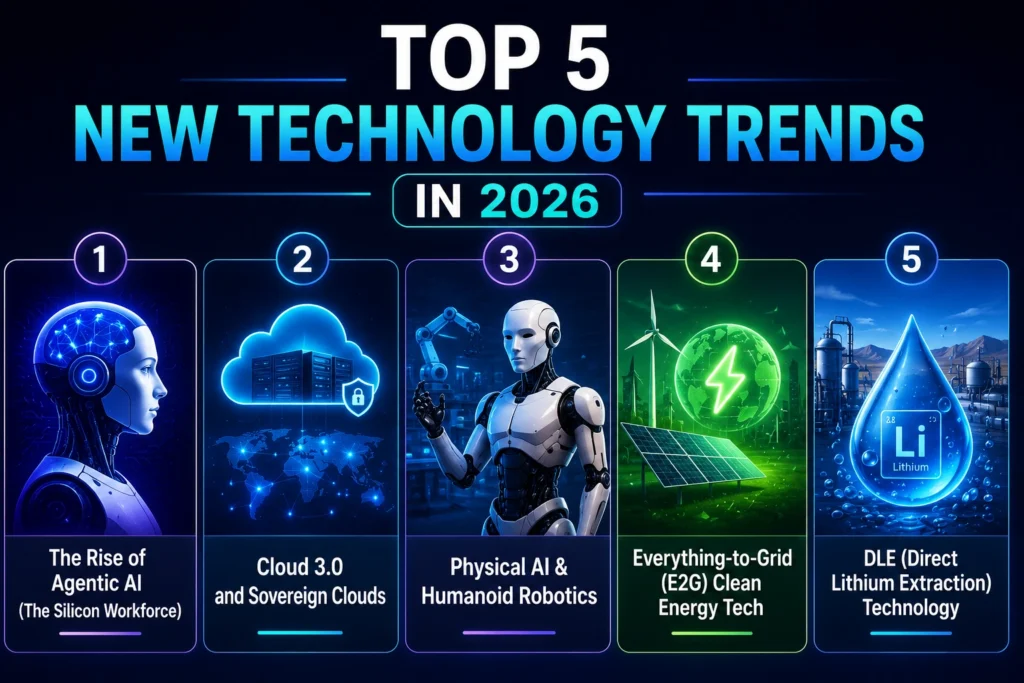
Here are the top 5 revolutionary tech updates defining this year.

1. The Rise of Agentic AI (The Silicon Workforce)

While previous years were dominated by conversational chatbots that responded to simple prompts, 2026 belongs to Agentic AI.

  • What it is: These advanced AI agents do not just answer questions; they are fully autonomous systems capable of executing complex, multi-step tasks from start to finish without human intervention.

  • Real-world Impact: From writing entire software modules and managing digital marketing campaigns to handling complex customer operations, companies are now building a dedicated “Silicon Workforce” of AI employees to streamline workflows.

2. Cloud 3.0 and Sovereign Clouds

With data security threats rising globally and traditional cloud architectures feeling the strain of massive AI workloads, Cloud 3.0 has emerged as the new gold standard for enterprise infrastructure.

  • Data Sovereignty: Nations and regions are enforcing strict data privacy laws. As a result, Sovereign Clouds have become mainstream, ensuring that sensitive data is stored, processed, and kept strictly within its country of origin.

  • Edge Computing Integration: Cloud 3.0 shifts heavy AI computing closer to where the data is actually generated (the Edge). This drastic reduction in distance eliminates latency and makes real-time data processing seamless.

3. Physical AI & Humanoid Robotics

Artificial Intelligence is stepping out of the digital screen and entering the physical world. The convergence of generative AI models and hardware engineering has reached maturity in 2026.

  • Smart Factories: Giant warehouses and automotive assembly lines are now deploying highly advanced humanoid robots capable of heavy lifting, precision assembly, and complex sorting.

  • Contextual Awareness: Unlike legacy industrial robots, these machines possess deep physical AI, allowing them to understand their surroundings in real-time and work safely alongside human employees.

4. Everything-to-Grid (E2G) Clean Energy Tech

Sustainability is no longer just a corporate goal; it is backed by powerful engineering. The rollout of Everything-to-Grid (E2G) technology is changing how the world manages power.

  • Dynamic Power Sharing: When electric vehicles (EVs) or large data center back-up systems sit idle, their massive battery capacities are utilized to feed electricity back into the main public power grid during peak demand hours.

  • The Benefit: This decentralized power sharing drastically reduces the strain on traditional thermal power plants, cuts carbon emissions, and builds a highly resilient energy infrastructure.

5. DLE (Direct Lithium Extraction) Technology

As electric mobility and high-performance electronic gadgets continue to explode in popularity, Lithium remains highly sought-after. To meet this massive demand, DLE Technology has completely disrupted the mining sector.

  • Instant Extraction: Traditional lithium mining relied on giant evaporation ponds that took up to two years to process. DLE technology extracts pure lithium from brine (salty water) in just a matter of hours.

  • Market Impact: This breakthrough has drastically accelerated the battery supply chain, reduced the environmental footprint of mining, and lowered production costs for consumer electronics.

Conclusion

The year 2026 is less about making promises and more about real-world action. From autonomous Agentic AI to clean energy grids, these trends showcase how the physical and digital worlds are permanently blending together. Adapting to these changes isn’t just an option anymore—it’s essential for staying relevant.

Which of these tech trends do you think will impact your daily life the most? Let us know your thoughts in the comments below!

Leave a Reply

Your email address will not be published. Required fields are marked *

Previous Post
Next Post

Subscribe to Our Newsletter

    © 2026 FindBrief. All Rights Reserved.

    Which language are you reading?

    Apni pasandida bhasha chunein

    • English
    • हिन्दी (Hindi)
    • বাংলা (Bengali)
    • தமிழ் (Tamil)
    • తెలుగు (Telugu)
    • मराठी (Marathi)
    • ગુજરાતી (Gujarati)
    • ಕನ್ನಡ (Kannada)
    • മലയാളം (Malayalam)
    • ਪੰਜਾਬੀ (Punjabi)
    • ଓଡ଼ିଆ (Odia)
    • اردو (Urdu)
    • অসমীয়া (Assamese)
    • भोजपुरी (Bhojpuri)
    • मैथिली (Maithili)
    • डोगरी (Dogri)
    • कोंकणी (Konkani)
    • संस्कृत (Sanskrit)
    • سنڌي (Sindhi)
    • नेपाली (Nepali)
    • සිංහල (Sinhala)
    • Español (Spanish)
    • Français (French)
    • Deutsch (German)
    • Italiano (Italian)
    • Português (Portuguese)
    • Русский (Russian)
    • 日本語 (Japanese)
    • 한국어 (Korean)
    • 中文 简体 (Chinese Simplified)
    • 中文 繁體 (Chinese Traditional)
    • العربية (Arabic)
    • עברית (Hebrew)
    • فارسی (Persian)
    • Türkçe (Turkish)
    • Nederlands (Dutch)
    • Svenska (Swedish)
    • Norsk (Norwegian)
    • Dansk (Danish)
    • Suomi (Finnish)
    • Polski (Polish)
    • Čeština (Czech)
    • Slovenčina (Slovak)
    • Slovenščina (Slovenian)
    • Magyar (Hungarian)
    • Română (Romanian)
    • Български (Bulgarian)
    • Українська (Ukrainian)
    • Ελληνικά (Greek)
    • Hrvatski (Croatian)
    • Српски (Serbian)
    • ไทย (Thai)
    • Tiếng Việt (Vietnamese)
    • Bahasa Indonesia (Indonesian)
    • Bahasa Melayu (Malay)
    • Filipino
    • မြန်မာ (Burmese)
    • ខ្មែរ (Khmer)
    • ລາວ (Lao)
    • Монгол (Mongolian)
    • Қазақ (Kazakh)
    • Oʻzbek (Uzbek)
    • Кыргызча (Kyrgyz)
    • Тоҷикӣ (Tajik)
    • Türkmen (Turkmen)
    • Azərbaycan (Azerbaijani)
    • Հայերեն (Armenian)
    • ქართული (Georgian)
    • Беларуская (Belarusian)
    • Lietuvių (Lithuanian)
    • Latviešu (Latvian)
    • Eesti (Estonian)
    • Íslenska (Icelandic)
    • Gaeilge (Irish)
    • Gàidhlig (Scots Gaelic)
    • Cymraeg (Welsh)
    • Euskara (Basque)
    • Català (Catalan)
    • Galego (Galician)
    • Malti (Maltese)
    • Македонски (Macedonian)
    • Bosanski (Bosnian)
    • Shqip (Albanian)
    • Afrikaans
    • Kiswahili (Swahili)
    • አማርኛ (Amharic)
    • Hausa
    • Igbo
    • Yorùbá (Yoruba)
    • isiZulu (Zulu)
    • isiXhosa (Xhosa)
    • Sesotho
    • Sepedi
    • Shona
    • Soomaali (Somali)
    • Kinyarwanda
    • Chichewa
    • ትግርኛ (Tigrinya)
    • Oromoo (Oromo)
    • Xitsonga (Tsonga)
    • Luganda
    • Akan (Twi)
    • Lëtzebuergesch (Luxembourgish)
    • Frysk (Frisian)
    • Corsu (Corsican)
    • Esperanto
    • Latina (Latin)
    • Basa Jawa (Javanese)
    • Basa Sunda (Sundanese)
    • Cebuano
    • ʻŌlelo Hawaiʻi (Hawaiian)
    • Gagana Samoa (Samoan)
    • Te Reo Māori (Maori)
    • Kreyòl Ayisyen (Haitian Creole)
    • Runasimi (Quechua)
    • Aymar Aru (Aymara)
    • Avañeʼẽ (Guarani)
    • Kurdî (Kurdish)
    • کوردیی ناوەندی (Kurdish Sorani)
    • پښتو (Pashto)
    • ئۇيغۇرچە (Uyghur)
    • ދިވެހި (Dhivehi)
    • ייִדיש (Yiddish)
    • Krio
    • Mizo
    • Manipuri (Meiteilon)
    • Eʋegbe (Ewe)
    • Lingála
    • Bamanankan (Bambara)
    • Hmoob (Hmong)
    • Ilokano
    Scroll to Top