


• English
  • हिन्दी (Hindi)
  • বাংলা (Bengali)
  • தமிழ் (Tamil)
  • తెలుగు (Telugu)
  • मराठी (Marathi)
  • ગુજરાતી (Gujarati)
  • ಕನ್ನಡ (Kannada)
  • മലയാളം (Malayalam)
  • ਪੰਜਾਬੀ (Punjabi)
  • ଓଡ଼ିଆ (Odia)
  • اردو (Urdu)
  • অসমীয়া (Assamese)
  • भोजपुरी (Bhojpuri)
  • मैथिली (Maithili)
  • डोगरी (Dogri)
  • कोंकणी (Konkani)
  • संस्कृत (Sanskrit)
  • سنڌي (Sindhi)
  • नेपाली (Nepali)
  • සිංහල (Sinhala)
  • Español (Spanish)
  • Français (French)
  • Deutsch (German)
  • Italiano (Italian)
  • Português (Portuguese)
  • Русский (Russian)
  • 日本語 (Japanese)
  • 한국어 (Korean)
  • 中文 简体 (Chinese Simplified)
  • 中文 繁體 (Chinese Traditional)
  • العربية (Arabic)
  • עברית (Hebrew)
  • فارسی (Persian)
  • Türkçe (Turkish)
  • Nederlands (Dutch)
  • Svenska (Swedish)
  • Norsk (Norwegian)
  • Dansk (Danish)
  • Suomi (Finnish)
  • Polski (Polish)
  • Čeština (Czech)
  • Slovenčina (Slovak)
  • Slovenščina (Slovenian)
  • Magyar (Hungarian)
  • Română (Romanian)
  • Български (Bulgarian)
  • Українська (Ukrainian)
  • Ελληνικά (Greek)
  • Hrvatski (Croatian)
  • Српски (Serbian)
  • ไทย (Thai)
  • Tiếng Việt (Vietnamese)
  • Bahasa Indonesia (Indonesian)
  • Bahasa Melayu (Malay)
  • Filipino
  • မြန်မာ (Burmese)
  • ខ្មែរ (Khmer)
  • ລາວ (Lao)
  • Монгол (Mongolian)
  • Қазақ (Kazakh)
  • Oʻzbek (Uzbek)
  • Кыргызча (Kyrgyz)
  • Тоҷикӣ (Tajik)
  • Türkmen (Turkmen)
  • Azərbaycan (Azerbaijani)
  • Հայերեն (Armenian)
  • ქართული (Georgian)
  • Беларуская (Belarusian)
  • Lietuvių (Lithuanian)
  • Latviešu (Latvian)
  • Eesti (Estonian)
  • Íslenska (Icelandic)
  • Gaeilge (Irish)
  • Gàidhlig (Scots Gaelic)
  • Cymraeg (Welsh)
  • Euskara (Basque)
  • Català (Catalan)
  • Galego (Galician)
  • Malti (Maltese)
  • Македонски (Macedonian)
  • Bosanski (Bosnian)
  • Shqip (Albanian)
  • Afrikaans
  • Kiswahili (Swahili)
  • አማርኛ (Amharic)
  • Hausa
  • Igbo
  • Yorùbá (Yoruba)
  • isiZulu (Zulu)
  • isiXhosa (Xhosa)
  • Sesotho
  • Sepedi
  • Shona
  • Soomaali (Somali)
  • Kinyarwanda
  • Chichewa
  • ትግርኛ (Tigrinya)
  • Oromoo (Oromo)
  • Xitsonga (Tsonga)
  • Luganda
  • Akan (Twi)
  • Lëtzebuergesch (Luxembourgish)
  • Frysk (Frisian)
  • Corsu (Corsican)
  • Esperanto
  • Latina (Latin)
  • Basa Jawa (Javanese)
  • Basa Sunda (Sundanese)
  • Cebuano
  • ʻŌlelo Hawaiʻi (Hawaiian)
  • Gagana Samoa (Samoan)
  • Te Reo Māori (Maori)
  • Kreyòl Ayisyen (Haitian Creole)
  • Runasimi (Quechua)
  • Aymar Aru (Aymara)
  • Avañeʼẽ (Guarani)
  • Kurdî (Kurdish)
  • کوردیی ناوەندی (Kurdish Sorani)
  • پښتو (Pashto)
  • ئۇيغۇرچە (Uyghur)
  • ދިވެހި (Dhivehi)
  • ייִדיש (Yiddish)
  • Krio
  • Mizo
  • Manipuri (Meiteilon)
  • Eʋegbe (Ewe)
  • Lingála
  • Bamanankan (Bambara)
  • Hmoob (Hmong)
  • Ilokano

Claude AI Features Explained: A Complete Guide

Claude, built by Anthropic, has grown into one of the most capable AI assistants available today….

Gagan Saxena

Writer & Blogger

Gagan Saxena

Managing Editor

Claude AI Features Explained

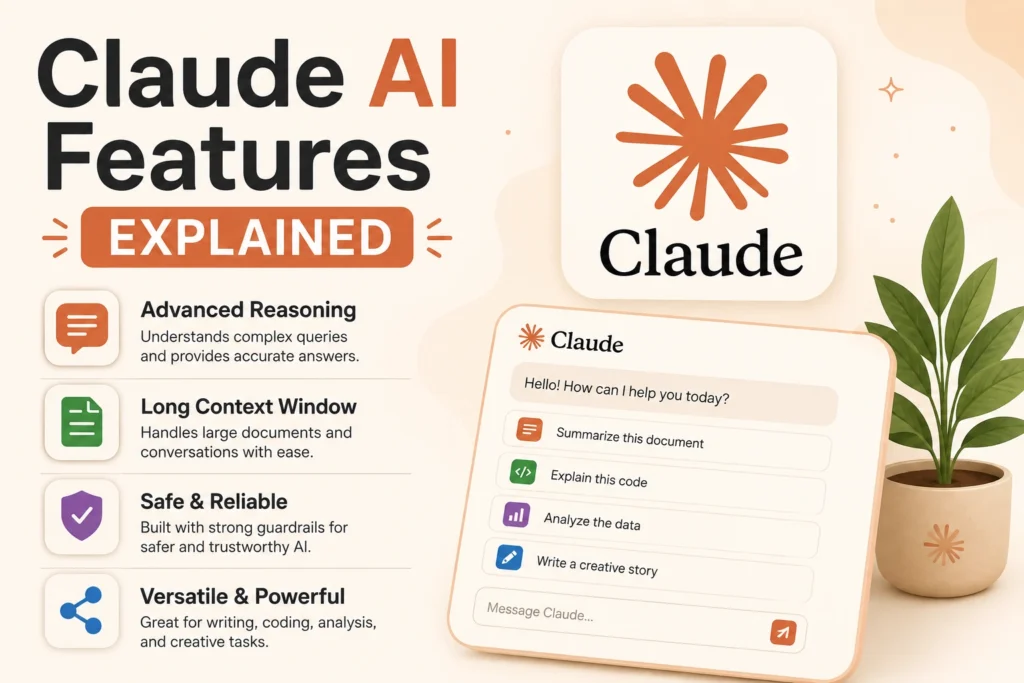
Claude, built by Anthropic, has grown into one of the most capable AI assistants available today. It is no longer just a chatbot that answers questions. It has become a full workspace where people write code, build documents, research topics, and automate real tasks. If you are trying to understand what Claude can actually do, this guide breaks down every major feature in plain language.

1. Chat with Artifacts

At its core, Claude is a conversational AI you can talk to through the web, desktop, or mobile app. What makes it different from a plain chatbot is a feature called Artifacts. When you ask Claude to build something like a code snippet, a document, a spreadsheet, or a slide deck, it opens that output in a separate panel next to the chat. You can view it, edit it, and reuse it without losing the conversation thread. This is especially useful for anyone building websites, writing reports, or prototyping small tools.

2. Claude Code

Claude Code is Anthropic’s coding-focused product. It lets developers hand off coding tasks directly from the terminal, VS Code, JetBrains, or the desktop app. Instead of copy-pasting code back and forth, Claude Code can read your repository, make changes, fix bugs, and even run tests. For agencies and freelance developers managing multiple client projects, this cuts down a lot of manual back-and-forth.

3. Claude Cowork

Cowork is aimed at people who are not developers but still need to get heavy, multi-step work done. Think research projects, long-form content pipelines, or tasks that involve juggling several tools and files at once. Cowork can be accessed on desktop and remotely through the mobile app, making it useful for teams that want to delegate entire workflows instead of single prompts.

4. Claude in Chrome

This turns Claude into a browsing agent. It can navigate websites, fill out forms, and complete actions inside your browser on your behalf. This is useful for repetitive web-based tasks that would otherwise eat up time manually.

5. Claude in Excel and Claude in PowerPoint

For spreadsheet-heavy or presentation-heavy work, Claude has dedicated integrations inside Excel and PowerPoint. It can build formulas, clean up messy data, generate charts, and put together slide decks directly inside the applications people already use daily.

6. Claude Tag for Slack

Teams that live inside Slack can tag @Claude directly in a channel or DM to delegate a task. This “multiplayer” style access means anyone on the team can pull Claude into a conversation without switching to a separate app.

7. Web Search and Deep Research

Claude can search the web for current information and compile it into a structured research summary. This is helpful when you need up-to-date facts, competitive research, or a broad overview of a topic that goes beyond a quick answer.

8. File Creation

Claude can generate real files such as Word documents, PDFs, Excel sheets, and PowerPoint presentations, ready to download. This is a major time-saver for anyone producing client deliverables, reports, or structured documents regularly.

9. Memory

Claude can remember details from past conversations, so it does not need to be re-briefed every single time. Over multiple sessions, it can recall your projects, preferences, and working style, which makes ongoing work feel more continuous.

Free vs Paid Access

Anthropic offers Claude through multiple plans, generally structured as Free, Pro, Team, and Enterprise tiers, along with API access for developers who want to build their own products on top of Claude. Feature availability, usage limits, and pricing details change over time and depend on your specific plan, so the most reliable place to check current details is Anthropic’s own support page rather than any third-party summary.

FindBrief Insight

The direction Claude has taken says a lot about where AI tools are heading in general. It is less about being a novelty chatbot and more about becoming an operating layer across the tools people already use, whether that is a browser, a spreadsheet, a codebase, or a Slack channel. For solo founders and small teams especially, this matters because it removes the friction of switching between five different apps to get one task done.

Leave a Reply

Your email address will not be published. Required fields are marked *

Previous Post

Subscribe to Our Newsletter

    © 2026 FindBrief. All Rights Reserved.

    Which language are you reading?

    Apni pasandida bhasha chunein

    • English
    • हिन्दी (Hindi)
    • বাংলা (Bengali)
    • தமிழ் (Tamil)
    • తెలుగు (Telugu)
    • मराठी (Marathi)
    • ગુજરાતી (Gujarati)
    • ಕನ್ನಡ (Kannada)
    • മലയാളം (Malayalam)
    • ਪੰਜਾਬੀ (Punjabi)
    • ଓଡ଼ିଆ (Odia)
    • اردو (Urdu)
    • অসমীয়া (Assamese)
    • भोजपुरी (Bhojpuri)
    • मैथिली (Maithili)
    • डोगरी (Dogri)
    • कोंकणी (Konkani)
    • संस्कृत (Sanskrit)
    • سنڌي (Sindhi)
    • नेपाली (Nepali)
    • සිංහල (Sinhala)
    • Español (Spanish)
    • Français (French)
    • Deutsch (German)
    • Italiano (Italian)
    • Português (Portuguese)
    • Русский (Russian)
    • 日本語 (Japanese)
    • 한국어 (Korean)
    • 中文 简体 (Chinese Simplified)
    • 中文 繁體 (Chinese Traditional)
    • العربية (Arabic)
    • עברית (Hebrew)
    • فارسی (Persian)
    • Türkçe (Turkish)
    • Nederlands (Dutch)
    • Svenska (Swedish)
    • Norsk (Norwegian)
    • Dansk (Danish)
    • Suomi (Finnish)
    • Polski (Polish)
    • Čeština (Czech)
    • Slovenčina (Slovak)
    • Slovenščina (Slovenian)
    • Magyar (Hungarian)
    • Română (Romanian)
    • Български (Bulgarian)
    • Українська (Ukrainian)
    • Ελληνικά (Greek)
    • Hrvatski (Croatian)
    • Српски (Serbian)
    • ไทย (Thai)
    • Tiếng Việt (Vietnamese)
    • Bahasa Indonesia (Indonesian)
    • Bahasa Melayu (Malay)
    • Filipino
    • မြန်မာ (Burmese)
    • ខ្មែរ (Khmer)
    • ລາວ (Lao)
    • Монгол (Mongolian)
    • Қазақ (Kazakh)
    • Oʻzbek (Uzbek)
    • Кыргызча (Kyrgyz)
    • Тоҷикӣ (Tajik)
    • Türkmen (Turkmen)
    • Azərbaycan (Azerbaijani)
    • Հայերեն (Armenian)
    • ქართული (Georgian)
    • Беларуская (Belarusian)
    • Lietuvių (Lithuanian)
    • Latviešu (Latvian)
    • Eesti (Estonian)
    • Íslenska (Icelandic)
    • Gaeilge (Irish)
    • Gàidhlig (Scots Gaelic)
    • Cymraeg (Welsh)
    • Euskara (Basque)
    • Català (Catalan)
    • Galego (Galician)
    • Malti (Maltese)
    • Македонски (Macedonian)
    • Bosanski (Bosnian)
    • Shqip (Albanian)
    • Afrikaans
    • Kiswahili (Swahili)
    • አማርኛ (Amharic)
    • Hausa
    • Igbo
    • Yorùbá (Yoruba)
    • isiZulu (Zulu)
    • isiXhosa (Xhosa)
    • Sesotho
    • Sepedi
    • Shona
    • Soomaali (Somali)
    • Kinyarwanda
    • Chichewa
    • ትግርኛ (Tigrinya)
    • Oromoo (Oromo)
    • Xitsonga (Tsonga)
    • Luganda
    • Akan (Twi)
    • Lëtzebuergesch (Luxembourgish)
    • Frysk (Frisian)
    • Corsu (Corsican)
    • Esperanto
    • Latina (Latin)
    • Basa Jawa (Javanese)
    • Basa Sunda (Sundanese)
    • Cebuano
    • ʻŌlelo Hawaiʻi (Hawaiian)
    • Gagana Samoa (Samoan)
    • Te Reo Māori (Maori)
    • Kreyòl Ayisyen (Haitian Creole)
    • Runasimi (Quechua)
    • Aymar Aru (Aymara)
    • Avañeʼẽ (Guarani)
    • Kurdî (Kurdish)
    • کوردیی ناوەندی (Kurdish Sorani)
    • پښتو (Pashto)
    • ئۇيغۇرچە (Uyghur)
    • ދިވެހި (Dhivehi)
    • ייִדיש (Yiddish)
    • Krio
    • Mizo
    • Manipuri (Meiteilon)
    • Eʋegbe (Ewe)
    • Lingála
    • Bamanankan (Bambara)
    • Hmoob (Hmong)
    • Ilokano
    Scroll to Top