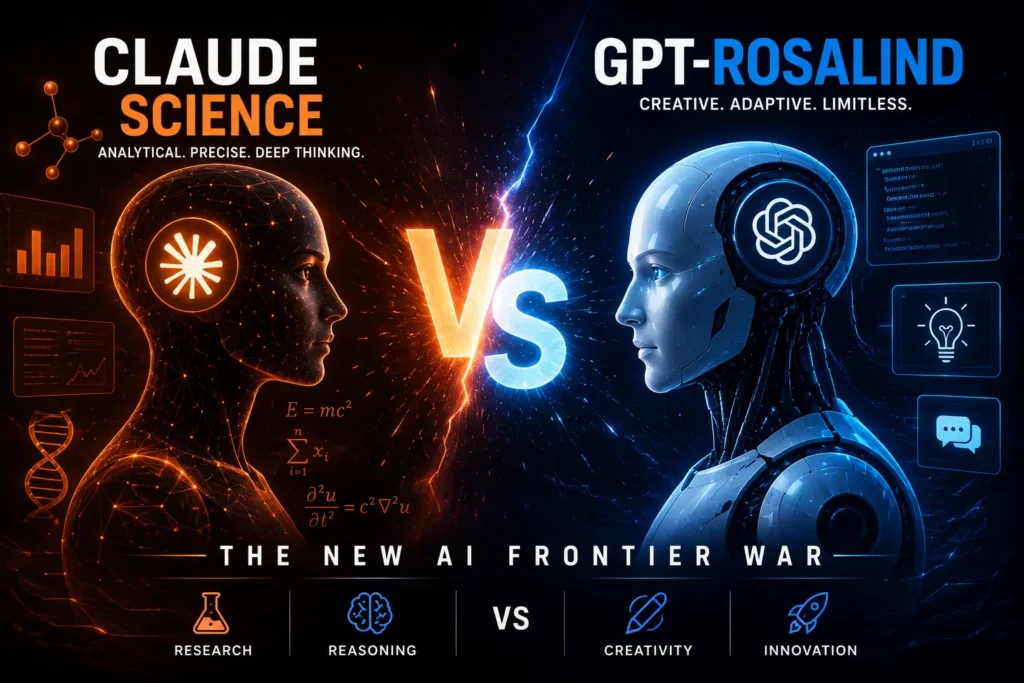




Anthropic’s Claude Science takes on OpenAI’s GPT-Rosalind. Here’s how these specialized research AI platforms actually compare in 2026.
- English
- हिन्दी (Hindi)
- বাংলা (Bengali)
- தமிழ் (Tamil)
- తెలుగు (Telugu)
- मराठी (Marathi)
- ગુજરાતી (Gujarati)
- ಕನ್ನಡ (Kannada)
- മലയാളം (Malayalam)
- ਪੰਜਾਬੀ (Punjabi)
- ଓଡ଼ିଆ (Odia)
- اردو (Urdu)
- অসমীয়া (Assamese)
- भोजपुरी (Bhojpuri)
- मैथिली (Maithili)
- डोगरी (Dogri)
- कोंकणी (Konkani)
- संस्कृत (Sanskrit)
- سنڌي (Sindhi)
- नेपाली (Nepali)
- සිංහල (Sinhala)
- Español (Spanish)
- Français (French)
- Deutsch (German)
- Italiano (Italian)
- Português (Portuguese)
- Русский (Russian)
- 日本語 (Japanese)
- 한국어 (Korean)
- 中文 简体 (Chinese Simplified)
- 中文 繁體 (Chinese Traditional)
- العربية (Arabic)
- עברית (Hebrew)
- فارسی (Persian)
- Türkçe (Turkish)
- Nederlands (Dutch)
- Svenska (Swedish)
- Norsk (Norwegian)
- Dansk (Danish)
- Suomi (Finnish)
- Polski (Polish)
- Čeština (Czech)
- Slovenčina (Slovak)
- Slovenščina (Slovenian)
- Magyar (Hungarian)
- Română (Romanian)
- Български (Bulgarian)
- Українська (Ukrainian)
- Ελληνικά (Greek)
- Hrvatski (Croatian)
- Српски (Serbian)
- ไทย (Thai)
- Tiếng Việt (Vietnamese)
- Bahasa Indonesia (Indonesian)
- Bahasa Melayu (Malay)
- Filipino
- မြန်မာ (Burmese)
- ខ្មែរ (Khmer)
- ລາວ (Lao)
- Монгол (Mongolian)
- Қазақ (Kazakh)
- Oʻzbek (Uzbek)
- Кыргызча (Kyrgyz)
- Тоҷикӣ (Tajik)
- Türkmen (Turkmen)
- Azərbaycan (Azerbaijani)
- Հայերեն (Armenian)
- ქართული (Georgian)
- Беларуская (Belarusian)
- Lietuvių (Lithuanian)
- Latviešu (Latvian)
- Eesti (Estonian)
- Íslenska (Icelandic)
- Gaeilge (Irish)
- Gàidhlig (Scots Gaelic)
- Cymraeg (Welsh)
- Euskara (Basque)
- Català (Catalan)
- Galego (Galician)
- Malti (Maltese)
- Македонски (Macedonian)
- Bosanski (Bosnian)
- Shqip (Albanian)
- Afrikaans
- Kiswahili (Swahili)
- አማርኛ (Amharic)
- Hausa
- Igbo
- Yorùbá (Yoruba)
- isiZulu (Zulu)
- isiXhosa (Xhosa)
- Sesotho
- Sepedi
- Shona
- Soomaali (Somali)
- Kinyarwanda
- Chichewa
- ትግርኛ (Tigrinya)
- Oromoo (Oromo)
- Xitsonga (Tsonga)
- Luganda
- Akan (Twi)
- Lëtzebuergesch (Luxembourgish)
- Frysk (Frisian)
- Corsu (Corsican)
- 🌐Esperanto
- Latina (Latin)
- Basa Jawa (Javanese)
- Basa Sunda (Sundanese)
- Cebuano
- ʻŌlelo Hawaiʻi (Hawaiian)
- Gagana Samoa (Samoan)
- Te Reo Māori (Maori)
- Kreyòl Ayisyen (Haitian Creole)
- Runasimi (Quechua)
- Aymar Aru (Aymara)
- Avañeʼẽ (Guarani)
- Kurdî (Kurdish)
- کوردیی ناوەندی (Kurdish Sorani)
- پښتو (Pashto)
- ئۇيغۇرچە (Uyghur)
- ދިވެހި (Dhivehi)
- 🌐ייִדיש (Yiddish)
- Krio
- Mizo
- Manipuri (Meiteilon)
- Eʋegbe (Ewe)
- Lingála
- Bamanankan (Bambara)
- Hmoob (Hmong)
- Ilokano