
• English
  • हिन्दी (Hindi)
  • বাংলা (Bengali)
  • தமிழ் (Tamil)
  • తెలుగు (Telugu)
  • मराठी (Marathi)
  • ગુજરાતી (Gujarati)
  • ಕನ್ನಡ (Kannada)
  • മലയാളം (Malayalam)
  • ਪੰਜਾਬੀ (Punjabi)
  • ଓଡ଼ିଆ (Odia)
  • اردو (Urdu)
  • অসমীয়া (Assamese)
  • भोजपुरी (Bhojpuri)
  • मैथिली (Maithili)
  • डोगरी (Dogri)
  • कोंकणी (Konkani)
  • संस्कृत (Sanskrit)
  • سنڌي (Sindhi)
  • नेपाली (Nepali)
  • සිංහල (Sinhala)
  • Español (Spanish)
  • Français (French)
  • Deutsch (German)
  • Italiano (Italian)
  • Português (Portuguese)
  • Русский (Russian)
  • 日本語 (Japanese)
  • 한국어 (Korean)
  • 中文 简体 (Chinese Simplified)
  • 中文 繁體 (Chinese Traditional)
  • العربية (Arabic)
  • עברית (Hebrew)
  • فارسی (Persian)
  • Türkçe (Turkish)
  • Nederlands (Dutch)
  • Svenska (Swedish)
  • Norsk (Norwegian)
  • Dansk (Danish)
  • Suomi (Finnish)
  • Polski (Polish)
  • Čeština (Czech)
  • Slovenčina (Slovak)
  • Slovenščina (Slovenian)
  • Magyar (Hungarian)
  • Română (Romanian)
  • Български (Bulgarian)
  • Українська (Ukrainian)
  • Ελληνικά (Greek)
  • Hrvatski (Croatian)
  • Српски (Serbian)
  • ไทย (Thai)
  • Tiếng Việt (Vietnamese)
  • Bahasa Indonesia (Indonesian)
  • Bahasa Melayu (Malay)
  • Filipino
  • မြန်မာ (Burmese)
  • ខ្មែរ (Khmer)
  • ລາວ (Lao)
  • Монгол (Mongolian)
  • Қазақ (Kazakh)
  • Oʻzbek (Uzbek)
  • Кыргызча (Kyrgyz)
  • Тоҷикӣ (Tajik)
  • Türkmen (Turkmen)
  • Azərbaycan (Azerbaijani)
  • Հայերեն (Armenian)
  • ქართული (Georgian)
  • Беларуская (Belarusian)
  • Lietuvių (Lithuanian)
  • Latviešu (Latvian)
  • Eesti (Estonian)
  • Íslenska (Icelandic)
  • Gaeilge (Irish)
  • Gàidhlig (Scots Gaelic)
  • Cymraeg (Welsh)
  • Euskara (Basque)
  • Català (Catalan)
  • Galego (Galician)
  • Malti (Maltese)
  • Македонски (Macedonian)
  • Bosanski (Bosnian)
  • Shqip (Albanian)
  • Afrikaans
  • Kiswahili (Swahili)
  • አማርኛ (Amharic)
  • Hausa
  • Igbo
  • Yorùbá (Yoruba)
  • isiZulu (Zulu)
  • isiXhosa (Xhosa)
  • Sesotho
  • Sepedi
  • Shona
  • Soomaali (Somali)
  • Kinyarwanda
  • Chichewa
  • ትግርኛ (Tigrinya)
  • Oromoo (Oromo)
  • Xitsonga (Tsonga)
  • Luganda
  • Akan (Twi)
  • Lëtzebuergesch (Luxembourgish)
  • Frysk (Frisian)
  • Corsu (Corsican)
  • Esperanto
  • Latina (Latin)
  • Basa Jawa (Javanese)
  • Basa Sunda (Sundanese)
  • Cebuano
  • ʻŌlelo Hawaiʻi (Hawaiian)
  • Gagana Samoa (Samoan)
  • Te Reo Māori (Maori)
  • Kreyòl Ayisyen (Haitian Creole)
  • Runasimi (Quechua)
  • Aymar Aru (Aymara)
  • Avañeʼẽ (Guarani)
  • Kurdî (Kurdish)
  • کوردیی ناوەندی (Kurdish Sorani)
  • پښتو (Pashto)
  • ئۇيغۇرچە (Uyghur)
  • ދިވެހި (Dhivehi)
  • ייִדיש (Yiddish)
  • Krio
  • Mizo
  • Manipuri (Meiteilon)
  • Eʋegbe (Ewe)
  • Lingála
  • Bamanankan (Bambara)
  • Hmoob (Hmong)
  • Ilokano

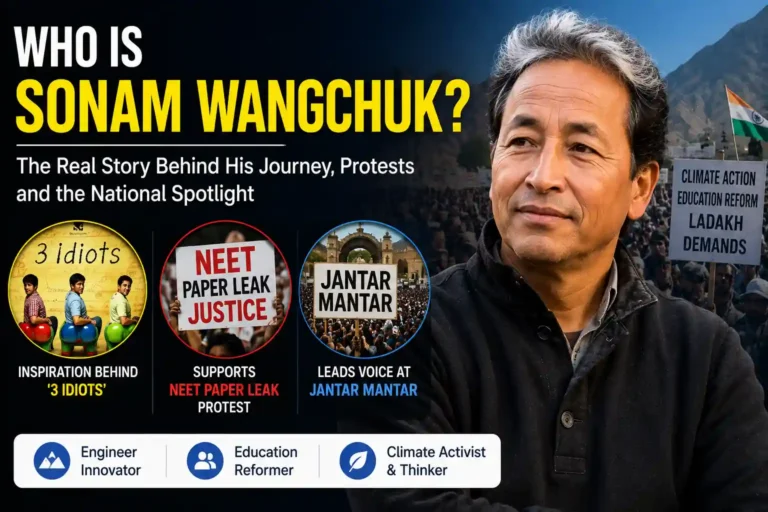
Who is Sonam Wangchuk? The Real Story Behind '3 Idiots', NEET Paper Leak Protest, and Jantar Mantar News

Who is Sonam Wangchuk? Discover the real story behind 3 Idiots’ ‘Phunsukh Wangdu’, his NEET paper leak stance, Jantar Mantar hunger strike, and key demands.

Gagan Saxena

Writer & Blogger

Gagan Saxena

Managing Editor

Sonam Wangchuk

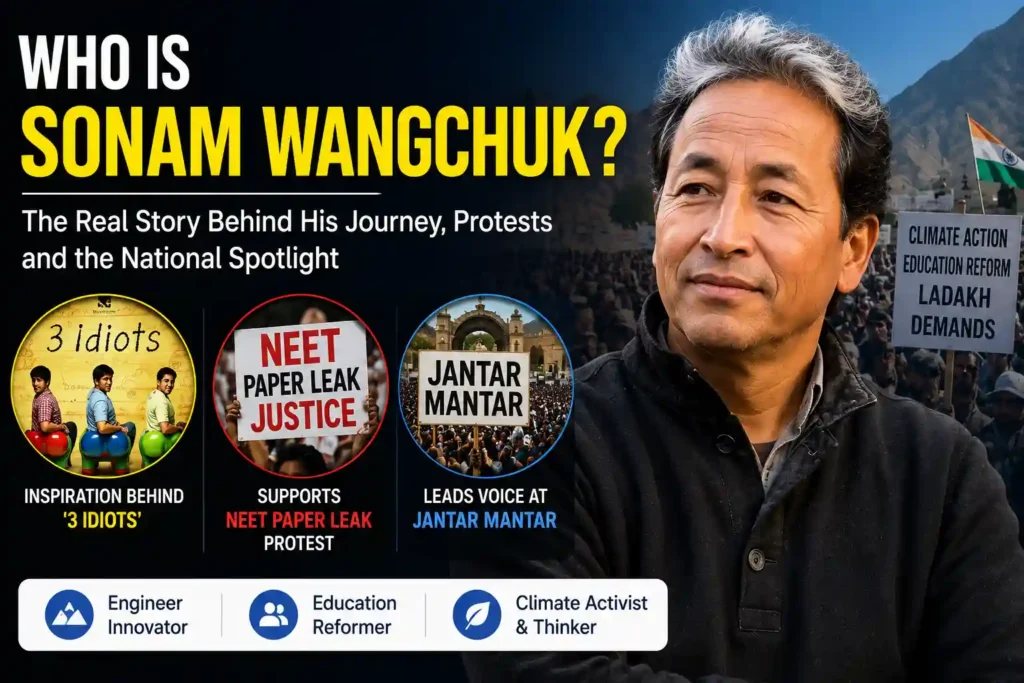
When the blockbuster film ‘3 Idiots’ was released in 2009, the character of ‘Phunsukh Wangdu’ (Rancho) captured the hearts of millions. He represented an ideal innovator—someone who prioritized practical learning, innovation, and social welfare over rote memorization.

However, many do not know that Phunsukh Wangdu was not purely fictional. The character was inspired by the real-life Indian innovator, engineer, and education reformer, Sonam Wangchuk.

Today, Sonam Wangchuk is back in national headlines following his indefinite hunger strike at Delhi’s Jantar Mantar over the NEET paper leak controversy, education reforms, and the rights of Ladakh. Here is a comprehensive look into who Sonam Wangchuk is, his stance on the NEET issue, and why prominent politicians and celebrities are extending their support.

Who is Sonam Wangchuk? (Biography & History)

Sonam Wangchuk was born in 1966 in Uletokpo village, Leh district, Ladakh. Due to a lack of schools in his village, he could not begin formal education until the age of nine. Despite early challenges, he pursued higher studies and earned his degree in Mechanical Engineering from NIT Srinagar.

Rather than taking up a comfortable corporate job, Wangchuk returned to Ladakh to reform the local educational landscape and improve living conditions in rural Himalayan communities.

His 3 Landmark Innovations:

  1. SECMOL (1988): He founded the Students’ Educational and Cultural Movement of Ladakh (SECMOL), an alternative school designed specifically for students failed by the traditional education system. The campus is fully solar-powered and focuses heavily on practical life skills.

  2. Ice Stupa: To address acute water scarcity during spring planting seasons in Ladakh, he engineered artificial glaciers called ‘Ice Stupas’. These 20 to 30-meter conical ice structures freeze winter water runoff and melt slowly in summer to supply irrigation water. He received the prestigious Rolex Award for Enterprise for this invention.

  3. Solar-Heated Tents: For Indian Army personnel deployed in sub-zero temperatures (-30°C) along the border, Wangchuk designed portable, solar-heated mud tents that maintain indoor temperatures at +15°C to +20°C without requiring kerosene or diesel fuel.

What is the Connection with the Movie ‘3 Idiots’?

Director Rajkumar Hirani visited Ladakh and spent time at the SECMOL campus, where he was deeply impressed by Sonam Wangchuk’s hands-on educational philosophies and eco-friendly inventions.

Aamir Khan’s character ‘Rancho Phunsukh Wangdu’ was largely modeled on Wangchuk’s real life, work, and core principles—epitomized by the iconic line: “Pursue excellence, and success will follow.”

Stance on the NEET Paper Leak Controversy

During the protests at Jantar Mantar, Sonam Wangchuk took a firm stand regarding the NEET-UG examination leaks, highlighting three critical issues:

  • Systemic Failure: Repeated leaks in high-stakes national examinations point to a complete breakdown in administrative and educational oversight.

  • Accountability & Transparency: Millions of students spend years preparing honestly. Testing agencies and governance bodies must uphold absolute integrity and accountability.

  • Student Mental Health: Recurring paper leaks and cancellations inflict severe psychological stress on young aspirants, demanding urgent structural intervention.

Key Demands of the Movement

Alongside student groups and civil society representatives at Jantar Mantar, the key demands raised include:

  1. Resignation of the Education Minister: Calling for moral accountability from the leadership regarding examination oversights.

  2. Overhaul of the Testing Mechanism: Restructuring NTA and national entrance examinations into a leak-proof, transparent system.

  3. Relief for Affected Families: Compensation and institutional support for families impacted by the ongoing examination crisis.

  4. Strict Legal Action: Independent investigation and stringent penalties against individuals and syndicates involved in paper leaks.

  5. Parliamentary Discussion & Ecological Protections: Dedicated debate on education reform in Parliament, alongside inclusion of Ladakh under the Sixth Schedule to protect regional ecology and indigenous rights.

Support from Leaders and Public Figures

As the protest progressed, several prominent political figures and celebrities expressed solidarity with Sonam Wangchuk and the student movement:

  • Political Figures: Opposition leaders including Rahul Gandhi, Mallikarjun Kharge, Akhilesh Yadav, and AAP MP Sanjay Singh supported calls for parliamentary discussions on examination reforms.

  • Cultural & Film Personalities: Public figures such as Imran Khan, Prakash Raj, Naseeruddin Shah, Shabana Azmi, and Anurag Kashyap voiced support for exam integrity and transparency.

Leave a Reply

Your email address will not be published. Required fields are marked *

Previous Post

Subscribe to Our Newsletter

    © 2026 FindBrief. All Rights Reserved.

    Which language are you reading?

    Apni pasandida bhasha chunein

    • English
    • हिन्दी (Hindi)
    • বাংলা (Bengali)
    • தமிழ் (Tamil)
    • తెలుగు (Telugu)
    • मराठी (Marathi)
    • ગુજરાતી (Gujarati)
    • ಕನ್ನಡ (Kannada)
    • മലയാളം (Malayalam)
    • ਪੰਜਾਬੀ (Punjabi)
    • ଓଡ଼ିଆ (Odia)
    • اردو (Urdu)
    • অসমীয়া (Assamese)
    • भोजपुरी (Bhojpuri)
    • मैथिली (Maithili)
    • डोगरी (Dogri)
    • कोंकणी (Konkani)
    • संस्कृत (Sanskrit)
    • سنڌي (Sindhi)
    • नेपाली (Nepali)
    • සිංහල (Sinhala)
    • Español (Spanish)
    • Français (French)
    • Deutsch (German)
    • Italiano (Italian)
    • Português (Portuguese)
    • Русский (Russian)
    • 日本語 (Japanese)
    • 한국어 (Korean)
    • 中文 简体 (Chinese Simplified)
    • 中文 繁體 (Chinese Traditional)
    • العربية (Arabic)
    • עברית (Hebrew)
    • فارسی (Persian)
    • Türkçe (Turkish)
    • Nederlands (Dutch)
    • Svenska (Swedish)
    • Norsk (Norwegian)
    • Dansk (Danish)
    • Suomi (Finnish)
    • Polski (Polish)
    • Čeština (Czech)
    • Slovenčina (Slovak)
    • Slovenščina (Slovenian)
    • Magyar (Hungarian)
    • Română (Romanian)
    • Български (Bulgarian)
    • Українська (Ukrainian)
    • Ελληνικά (Greek)
    • Hrvatski (Croatian)
    • Српски (Serbian)
    • ไทย (Thai)
    • Tiếng Việt (Vietnamese)
    • Bahasa Indonesia (Indonesian)
    • Bahasa Melayu (Malay)
    • Filipino
    • မြန်မာ (Burmese)
    • ខ្មែរ (Khmer)
    • ລາວ (Lao)
    • Монгол (Mongolian)
    • Қазақ (Kazakh)
    • Oʻzbek (Uzbek)
    • Кыргызча (Kyrgyz)
    • Тоҷикӣ (Tajik)
    • Türkmen (Turkmen)
    • Azərbaycan (Azerbaijani)
    • Հայերեն (Armenian)
    • ქართული (Georgian)
    • Беларуская (Belarusian)
    • Lietuvių (Lithuanian)
    • Latviešu (Latvian)
    • Eesti (Estonian)
    • Íslenska (Icelandic)
    • Gaeilge (Irish)
    • Gàidhlig (Scots Gaelic)
    • Cymraeg (Welsh)
    • Euskara (Basque)
    • Català (Catalan)
    • Galego (Galician)
    • Malti (Maltese)
    • Македонски (Macedonian)
    • Bosanski (Bosnian)
    • Shqip (Albanian)
    • Afrikaans
    • Kiswahili (Swahili)
    • አማርኛ (Amharic)
    • Hausa
    • Igbo
    • Yorùbá (Yoruba)
    • isiZulu (Zulu)
    • isiXhosa (Xhosa)
    • Sesotho
    • Sepedi
    • Shona
    • Soomaali (Somali)
    • Kinyarwanda
    • Chichewa
    • ትግርኛ (Tigrinya)
    • Oromoo (Oromo)
    • Xitsonga (Tsonga)
    • Luganda
    • Akan (Twi)
    • Lëtzebuergesch (Luxembourgish)
    • Frysk (Frisian)
    • Corsu (Corsican)
    • Esperanto
    • Latina (Latin)
    • Basa Jawa (Javanese)
    • Basa Sunda (Sundanese)
    • Cebuano
    • ʻŌlelo Hawaiʻi (Hawaiian)
    • Gagana Samoa (Samoan)
    • Te Reo Māori (Maori)
    • Kreyòl Ayisyen (Haitian Creole)
    • Runasimi (Quechua)
    • Aymar Aru (Aymara)
    • Avañeʼẽ (Guarani)
    • Kurdî (Kurdish)
    • کوردیی ناوەندی (Kurdish Sorani)
    • پښتو (Pashto)
    • ئۇيغۇرچە (Uyghur)
    • ދިވެހި (Dhivehi)
    • ייִדיש (Yiddish)
    • Krio
    • Mizo
    • Manipuri (Meiteilon)
    • Eʋegbe (Ewe)
    • Lingála
    • Bamanankan (Bambara)
    • Hmoob (Hmong)
    • Ilokano
    Scroll to Top