



Artificial intelligence has evolved far beyond simple chatbots that answer one question at a time.

What Are AI Agents?
An AI agent is a software system powered by artificial intelligence that can perceive its environment, make decisions, and take actions autonomously to achieve a specific goal. Instead of just generating text or images on request, an AI agent can:
- Understand a high-level objective
- Break that objective into smaller tasks
- Use tools, APIs, or software to complete those tasks
- Evaluate the results and adjust its approach
- Continue working until the goal is achieved
In simple terms, if a chatbot is like an assistant who answers your questions, an AI agent is like an assistant who can actually go out, complete the task, and report back once it’s done.
How Do AI Agents Work?
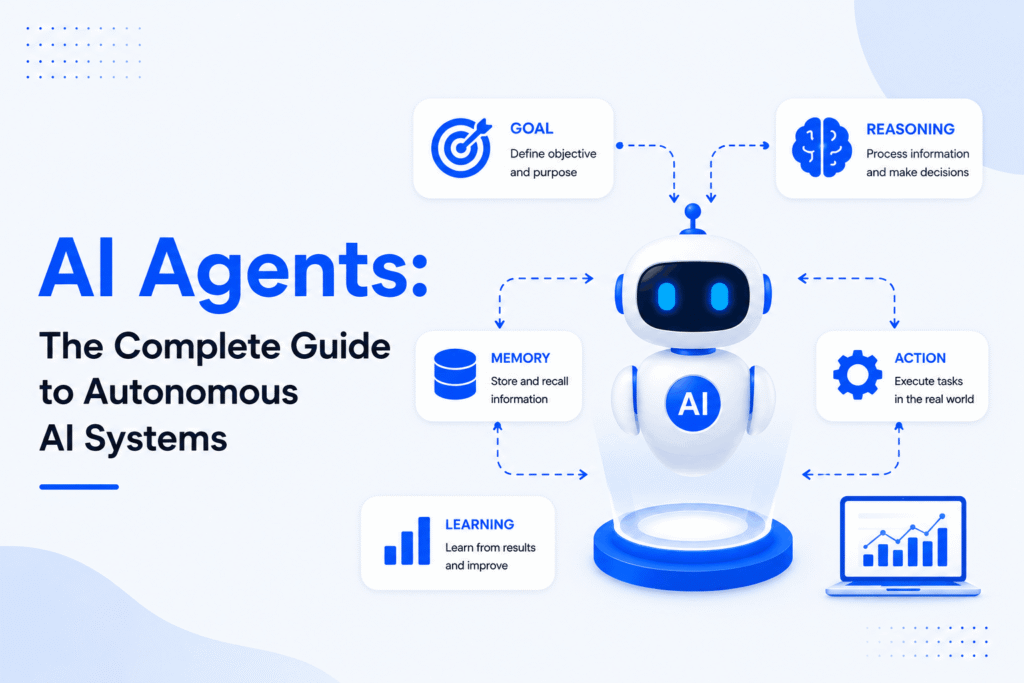
Most modern AI agents are built on top of large language models (LLMs) combined with additional components that give them the ability to act in the real world. Here’s a simplified breakdown of how they function:
1. Perception
The agent gathers information from its environment. This could be a user’s instructions, data from a database, content from a webpage, or output from another software tool.
2. Reasoning and Planning
Using its underlying language model, the agent analyzes the task, breaks it down into smaller steps, and decides the best sequence of actions to take. This is often called “chain-of-thought” reasoning.
3. Action
The agent executes tasks using tools — this might include searching the web, writing code, sending emails, updating a spreadsheet, or calling an API.
4. Memory
Many AI agents maintain short-term or long-term memory, allowing them to remember previous steps, learnings, or user preferences across a session or even across multiple sessions.
5. Feedback Loop
After taking action, the agent evaluates whether the outcome matches the goal. If not, it adjusts its plan and tries again — this loop continues until the task is complete.
Types of AI Agents
AI agents come in different forms depending on their complexity and purpose:
Simple Reflex Agents
These agents respond directly to specific inputs without considering history or context. They follow basic “if-then” rules.
Model-Based Agents
These maintain an internal model of the world, allowing them to make decisions based on both current input and past experience.
Goal-Based Agents
These agents work toward a defined objective, evaluating different action paths to determine which one best achieves the goal.
Utility-Based Agents
Beyond just achieving a goal, these agents try to find the most efficient or optimal way to do so, weighing trade-offs between different outcomes.
Learning Agents
These agents improve their performance over time by learning from feedback, mistakes, and new data.
Multi-Agent Systems
In more advanced setups, multiple specialized AI agents collaborate with each other — each handling a different part of a larger task — similar to how a team of human employees might divide responsibilities.
Key Components of an AI Agent Architecture
A well-designed AI agent typically includes the following core components:
- Large Language Model (LLM): The “brain” that handles reasoning, language understanding, and decision-making.
- Tools and APIs: External resources the agent can call to take real-world actions, such as web search, code execution, or database access.
- Memory Module: Stores context, past interactions, and relevant data for future reference.
- Planner: Breaks down complex goals into manageable, sequential tasks.
- Orchestrator: Coordinates the flow between reasoning, tool use, and memory to keep the agent on track.
AI Agents vs. Traditional AI Chatbots
| Feature | Traditional Chatbot | AI Agent |
|---|---|---|
| Interaction | Single question, single answer | Multi-step, goal-oriented |
| Autonomy | Requires constant user input | Can work independently |
| Tool Use | Limited or none | Can use multiple external tools |
| Memory | Often session-based only | Can retain long-term context |
| Task Complexity | Best for simple Q&A | Handles complex, multi-step workflows |
This distinction is why AI agents are often described as “agentic AI” — they don’t just respond, they act.
Real-World Applications of AI Agents
AI agents are already being used across multiple industries to automate and accelerate work:
Customer Support
AI agents can independently resolve customer queries by checking order status, processing refunds, or escalating complex issues — without human intervention for routine cases.
Software Development
Coding agents can write, test, debug, and even deploy code based on a developer’s instructions, significantly speeding up the development cycle.
Research and Data Analysis
Research agents can search the web, gather data from multiple sources, summarize findings, and compile structured reports automatically.
Sales and Marketing
AI agents can qualify leads, personalize outreach emails, schedule meetings, and update CRM systems without manual data entry.
Personal Productivity
From managing calendars to drafting emails and organizing tasks, personal AI agents are becoming digital assistants that handle day-to-day administrative work.
E-commerce
AI agents can manage inventory updates, track shipments, recommend products, and even negotiate prices within set parameters.
Benefits of Using AI Agents
- Increased Efficiency: Automates repetitive, multi-step tasks that would otherwise require human effort.
- 24/7 Availability: Agents can operate continuously without breaks.
- Scalability: A single agent system can handle thousands of tasks simultaneously.
- Reduced Human Error: Well-designed agents follow consistent logic, minimizing mistakes from fatigue or oversight.
- Faster Decision-Making: Agents can process and act on information much faster than manual workflows.
Challenges and Limitations of AI Agents
Despite their potential, AI agents face several real-world challenges:
- Reliability: Agents can sometimes make incorrect decisions or get stuck in repetitive loops.
- Security Risks: Giving an AI system autonomous access to tools and data introduces new security and privacy considerations.
- Cost: Running agents that make multiple reasoning and tool-use steps can be more resource-intensive than a single AI query.
- Oversight: Determining how much autonomy to grant an agent — and when human review is needed — remains an ongoing design challenge.
- Complexity: Building and maintaining a robust agent system requires careful engineering, testing, and monitoring.
Popular Approaches to Building AI Agents
Developers today build AI agents using a combination of large language models, orchestration frameworks, and tool integrations. Common approaches include:
- Single-agent systems designed for a specific, well-defined task
- Multi-agent systems where specialized agents collaborate, often with one agent acting as a coordinator
- Human-in-the-loop agents that pause for approval at key decision points before taking sensitive actions
Because this is a fast-moving space, the specific tools and frameworks available continue to evolve rapidly, so it’s worth checking current documentation when selecting a framework for a real project.
The Future of AI Agents
AI agents represent one of the most significant shifts in how we use artificial intelligence. As models become more capable of reasoning and using tools reliably, we can expect:
- More autonomous workflows across industries like healthcare, finance, and logistics
- Better collaboration between multiple agents, each specialized for specific tasks
- Improved safety and oversight mechanisms to ensure agents act within defined boundaries
- Wider adoption in everyday consumer tools, from personal assistants to smart home automation
As this technology matures, the line between “using AI” and “delegating work to AI” will continue to blur — making AI agents a core part of how both individuals and businesses operate.
Frequently Asked Questions (FAQs)
Q1. What is the difference between an AI agent and a chatbot? A chatbot typically responds to single queries, while an AI agent can plan, take multiple actions, use tools, and work toward a goal autonomously.
Q2. Are AI agents safe to use? AI agents can be safe when designed with proper oversight, permissions, and monitoring. However, like any autonomous system, they require careful security and access controls.
Q3. Can AI agents work without human supervision? Many AI agents can operate with minimal supervision, but most well-designed systems include human checkpoints for sensitive or high-stakes decisions.
Q4. What industries benefit most from AI agents? Customer service, software development, e-commerce, sales, marketing, and research are among the industries seeing the fastest adoption of AI agents.
Q5. Do AI agents replace human jobs? AI agents are generally designed to automate repetitive or time-consuming tasks, allowing humans to focus on more strategic, creative, or complex work — rather than fully replacing human roles.
Conclusion
AI agents are transforming the way we think about automation and artificial intelligence. By combining reasoning, memory, and the ability to take real-world actions, they go far beyond what traditional chatbots can do. As businesses and developers continue to explore agentic AI, understanding how these systems work — and where their strengths and limitations lie — will be essential for anyone looking to stay ahead in this rapidly evolving field.
Whether you’re building your first AI agent or simply exploring the technology, one thing is clear: AI agents are not just a trend — they’re shaping the next generation of intelligent automation.