Introduction
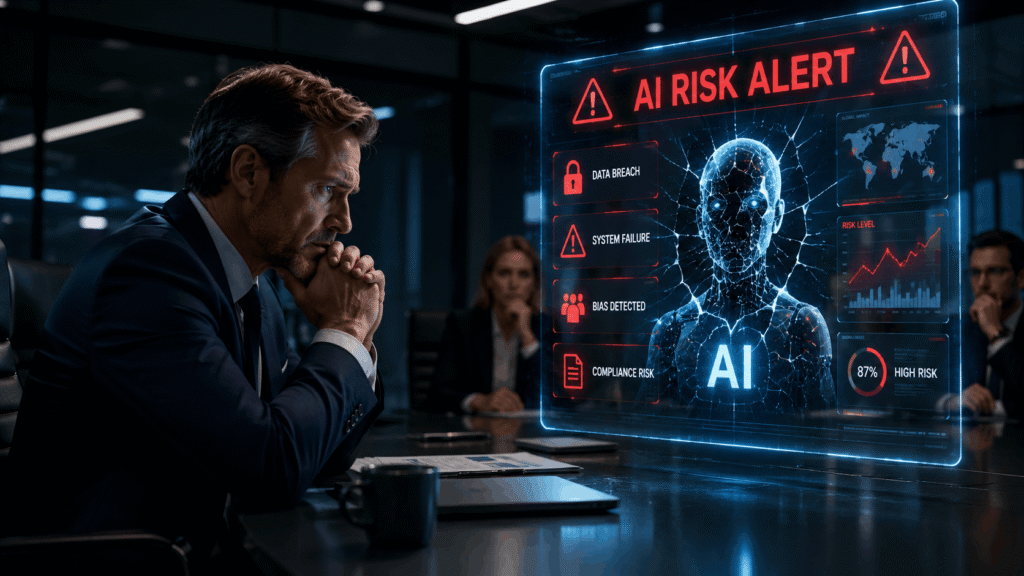
AI has changed how businesses run — automating grunt work, sharpening customer experiences, and feeding better decisions across the board. It’s become genuinely core to how modern organizations operate. But as adoption accelerates, cybersecurity professionals and global security experts are sounding a warning that’s hard to ignore: AI isn’t just an opportunity anymore — it’s becoming one of the biggest risks businesses face.
Boards and executives are being pushed to treat AI governance, cybersecurity, and compliance as strategic priorities, not side issues for the IT team to sort out. Get it wrong, and companies are looking at financial losses, legal exposure, reputational damage, and a wider attack surface for cyber threats.
Why AI Has Become a Business Risk
The problem isn’t AI itself — it’s the pace. Adoption has outrun the security controls and governance policies most organizations actually have in place. Employees are using generative AI tools daily — writing documents, generating code, analyzing data, automating workflows — often with zero oversight.
That gap opens up a handful of real risks:
- Sensitive information getting shared without authorization
- AI-generated misinformation slipping into business decisions
- New openings for cyberattacks
- Regulatory compliance violations
- Bad decisions made on the back of inaccurate AI outputs
AI absolutely boosts productivity — but it also introduces vulnerabilities that traditional cybersecurity playbooks were never built to catch.
Cybersecurity Threats Are Increasing
Cybersecurity sits at the center of this concern, and for good reason. Attackers are now using AI to automate their own operations — writing convincing phishing emails, generating malicious code, and scanning for weaknesses in corporate systems faster than defenders can patch them.
A few of the AI-powered threats showing up most often:
AI-Generated Phishing Attacks Today’s AI tools can produce phishing emails that are personalized and polished enough to pass for genuine communication from executives, partners, or trusted vendors — making them far harder for employees to catch.
Automated Malware Development AI is lowering the skill barrier for attackers, helping them write malicious software faster and launch more sophisticated attacks with less technical expertise required.
Deepfake Fraud Voice and video deepfakes are getting scarily convincing. Fraudsters are using them to impersonate executives on calls or video meetings, tricking employees into wiring money or handing over confidential information.
Faster Vulnerability Discovery Attackers can now scan thousands of systems at once using AI, finding security gaps well before organizations have a chance to patch them.
The Growing Challenge of AI Governance
AI governance is essentially the set of policies, controls, and oversight that keeps AI usage responsible and secure. The problem: a lot of organizations rolled out AI tools without building any governance framework around them first. That leaves employees using AI applications without really understanding the risks they’re carrying.
A solid AI governance approach usually includes:
- Clear AI usage policies
- Data protection guidelines
- Human oversight built into the process
- Ethical AI principles
- Continuous monitoring
- Regular risk assessments
The goal for leadership is simple: keep AI-driven decisions transparent and accountable, not a black box.
Data Privacy Concerns
AI systems routinely process huge volumes of sensitive data — customer records, financial information, healthcare data, intellectual property. If an employee pastes confidential information into a public AI platform, that data can end up stored or exposed somewhere completely outside the company’s control.
Businesses need clear policies covering:
- Customer data protection
- Employee information
- Confidential business documents
- Trade secrets
- Financial reports
Encryption, access controls, and proper data classification matter more than ever once AI tools enter the picture.
Regulatory Compliance Is Getting More Complex
Governments worldwide are rolling out regulations aimed at responsible AI development and use. Falling behind on compliance isn’t a minor issue — it can mean:
- Financial penalties
- Legal investigations
- Compliance violations
- Customer lawsuits
- Reputational damage
Staying ahead means treating regulatory tracking as an ongoing process, not a one-time checkbox — governance frameworks need to evolve as the rules do.
Shadow AI: The Hidden Risk Nobody’s Tracking
One of the quieter but more pressing concerns among security experts right now is Shadow AI — employees using AI tools that IT or security never approved.
A common example: someone uploads a confidential report into a public chatbot just to get a quick summary or a presentation draft. Convenient, sure — but it can expose sensitive company information and create real compliance headaches without anyone realizing it happened.
The fix isn’t banning AI — it’s giving employees approved tools and educating them on what’s safe to share.
Business Leaders Need to Own This
AI risk management can’t sit solely with the IT department anymore. CEOs, CISOs, board members, and senior executives all need to be actively involved in AI governance.
That means leadership should be:
- Developing AI risk strategies
- Allocating real cybersecurity budgets
- Establishing governance committees
- Reviewing AI policies on a regular cadence
- Actively promoting responsible AI adoption across teams
AI risk deserves a seat at the table alongside financial, operational, and legal risk during strategic planning — not an afterthought bolted on later.
Best Practices for Managing AI Risk
A few practical steps organizations can take to get ahead of this:
Build an AI governance framework — clear policies on how AI tools get selected, deployed, monitored, and evaluated.
Run regular risk assessments — check AI applications for security gaps, privacy risks, and compliance issues before they go live.
Strengthen core cybersecurity — multi-factor authentication, Zero Trust architecture, endpoint security, continuous monitoring, and active threat intelligence.
Train employees continuously — human error is still the biggest security risk out there. Ongoing training on AI security, phishing awareness, data privacy, and responsible AI usage matters more than any single tool.
Vet third-party AI vendors — before integrating any outside AI solution, check their data protection policies, compliance certifications, security audit history, and incident response capabilities.
Where This Is Headed
As AI keeps evolving, the risks tied to it will only get more sophisticated. Organizations that invest early in governance, cybersecurity, employee training, and responsible adoption will be the ones positioned to actually benefit from AI — without absorbing the downside.
Security experts expect AI governance to become a standard part of enterprise risk management within the next few years, much like financial auditing or cybersecurity compliance already are. The shift in mindset that matters most: stop treating AI purely as a productivity tool, and start treating it as a strategic asset that needs ongoing oversight and real leadership buy-in.
Conclusion
AI is transforming industries at a pace few technologies ever have — real opportunities for innovation, efficiency, and growth. But that same speed is creating challenges businesses can’t afford to shrug off. From AI-powered cyberattacks and data privacy gaps to governance failures and compliance risk, the stakes keep climbing.
Global security experts are clear on this: AI deserves the same level of attention as financial, operational, and cybersecurity risk. Companies that build strong governance, invest in security, train their people, and keep executives engaged will be far better positioned for what’s coming.
AI itself isn’t the danger — unmanaged AI is. Businesses that balance innovation with real risk management will come out ahead, protecting their assets, their customers, and their reputation along the way.
FAQs
Q1. Why is AI considered a business risk? Because unmanaged AI can expose businesses to cybersecurity threats, data privacy issues, compliance failures, and reputational damage.
Q2. What is AI governance? It’s the set of policies, controls, and oversight that ensures AI is used securely, ethically, and responsibly across an organization.
Q3. What is Shadow AI? Shadow AI refers to employees using AI tools that haven’t been approved by the organization’s IT or security team.
Q4. How can businesses reduce AI risk? By building governance frameworks, strengthening cybersecurity, training employees regularly, and running consistent risk assessments.
Q5. Is AI still worth adopting despite the risks? Yes — when managed responsibly, AI drives real gains in productivity, decision-making, automation, and long-term business growth.