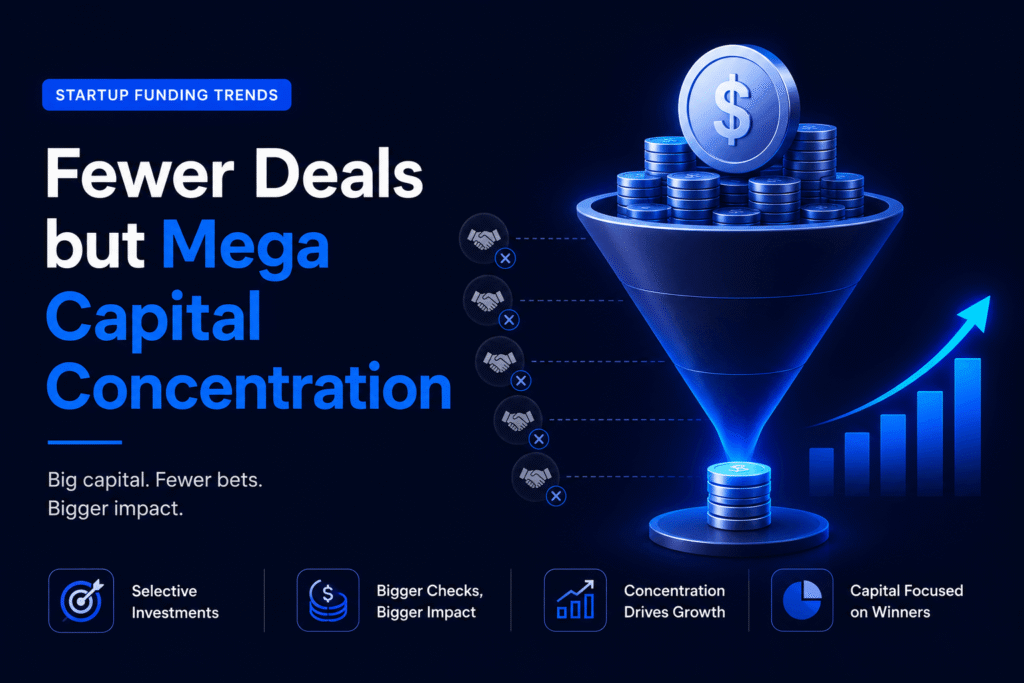
A Structural Shift, Not a Slowdown
Something has fundamentally changed in how venture capital moves through Indian tech — and it’s not what most people assume when they hear “deal volume is down.” The era of spreading small checks across dozens of early-stage bets is fading fast, replaced by a market where investors put serious money behind fewer, more proven companies. This is the story behind fewer deals but mega capital concentration, and it’s shaping up to be the defining trend of the current funding cycle.
This isn’t a blip or a temporary pullback — it looks like a lasting shift in how capital gets allocated. Investors are simply demanding more proof before they write a check: real unit economics, a credible path to revenue, something beyond a good pitch deck. Meanwhile, general-purpose software startups are finding it harder to raise, while deep-tech and core infrastructure plays are pulling in an outsized share of the money.
The Numbers: $7.2B Raised, But Only 652 Deals
The latest Tracxn India Tech H1 2026 (Half 1 of 2026)6 Geo Report lays out the divergence clearly. Total equity funding into Indian tech startups climbed 12% year-on-year to $7.2 billion in the first half of 2026. But that money went into just 652 deals — a steep 43% drop in deal count compared to the same period last year.
| Ecosystem Metric | H1 2026 | YoY Change (Year-over-Year Change) |
|---|
| Total Capital Deployed | $7.2 Billion | 12% increase |
| Total Funding Rounds | 652 | 43% decline |
| Top 3 Mega Deals’ Share | $2.2 Billion (31% of total) | Highly concentrated |
| New Unicorns Minted | 5 | Up from 4 in H1 2025 |
Put simply: more money, fewer companies getting it. Average check sizes are climbing because the same overall capital pool is now being split among less than half as many startups as a year ago. Investors haven’t lost interest in India — they’re just being far more selective about where that interest goes.
Depth Over Breadth: Why Mega Checks Are Winning
This “depth over breadth” approach means VCs are no longer scattering small bets across a wide field of early-stage experiments. They’re doubling down on companies that have already proven product-market fit. Nowhere is this clearer than in late-stage funding, which hit $3.8 billion in H1 2026 — spread across just 44 deals, the lowest late-stage deal count on record.
A handful of standout companies are soaking up a disproportionate share of all venture capital in the country. Three deals alone tell the story: fintech platform CRED raised $900 million, infrastructure provider Nxtra raised $710 million, and AI enterprise startup Neysa raised $600 million. Combined, that’s $2.2 billion — nearly 31% of all capital deployed across the entire Indian tech ecosystem, from just three transactions.
AI Startups Are Becoming Unicorns Faster Than Ever
While most startups are taking longer to scale in this tighter funding environment, AI-native companies are the clear exception — and they’re hitting billion-dollar valuations at a pace that would’ve seemed unrealistic just a few years ago.
Of the five new unicorns minted in H1 2026, two — Neysa and Sarvam AI — are AI-native companies that crossed unicorn status in under three years from founding. According to coverage from The Economic Times Tech Funding Report, Neysa got there in just 1.3 years, while Sarvam AI did it in 2.5 years — both on relatively lean pre-unicorn rounds of $50 million and $41 million respectively.
The pattern is pretty clear: when a startup builds on established AI frameworks and targets large enterprise customers, capital moves fast — much faster than the traditional startup playbook ever allowed.
What This Means for Founders Right Now
If you’re raising money in this environment, the old early-stage playbook needs an update. Even as the total number of seed rounds fell, the average check size for strong seed-stage startups nearly doubled to $5.5 million. Why? Because investors increasingly want to see a working, AI-driven prototype and early user traction before they commit — not just a promising idea.
At the same time, the exit side of the market is looking healthier. 13 tech startups completed IPOs in H1 2026, and the average market cap at listing jumped to $297 million, up from $162 million the year before. Even more telling: the average time from a startup’s first funding round to going public dropped from 14.5 years to 8.1 years.
The takeaway for founders is straightforward — the entry bar for raw ideas has gotten a lot higher, but for companies that get through it and execute well, the path to liquidity is opening up faster than ever.
FAQs
Q1: What does “Depth over Breadth” actually mean in startup funding? It means VCs are choosing to put larger amounts of capital into a smaller number of mature, high-performing companies, instead of spreading smaller checks across many early-stage bets.
Q2: Which companies raised the biggest funding rounds in India in H1 2026? The top three were CRED ($900 million), Nxtra ($710 million), and Neysa ($600 million) — together accounting for 31% of all capital raised across the ecosystem.
Q3: How fast are Indian AI startups becoming unicorns compared to traditional companies? Much faster. Neysa hit a $1 billion valuation in 1.3 years and Sarvam AI in 2.5 years, compared to 8–12 years for traditional consumer tech companies in earlier cycles.
Q4: Is overall startup funding in India actually declining? No — total funding is up. Startups raised $7.2 billion in H1 2026, a 12% increase year-on-year, even though the number of individual deals dropped by 43%.
Source: Tracxn Live Market Insights | The Economic Times Tech Coverage