Why This Launch Matters Right Now
AI’s center of gravity is shifting. For the last few years, the entire industry was obsessed with training bigger models. Now, the real bottleneck is running them — inference, at massive scale, for millions of users hitting these models every single day. That shift is exactly what’s pulled inference chip startup Etched out of stealth mode, backed by one of the largest funding rounds a hardware startup has seen in recent memory.
Cloud providers are watching their data center power bills spiral, and they’re hungry for alternatives to the general-purpose chips they’ve relied on for years. Instead of tweaking an existing GPU design to squeeze out more efficiency, Etched took the harder route: they built a chip from scratch, designed to do exactly one thing — run transformer models — and nothing else. That’s a bold bet, and it’s why the AI hardware world is paying attention.
The Money: $800M Raised, $5B Valuation
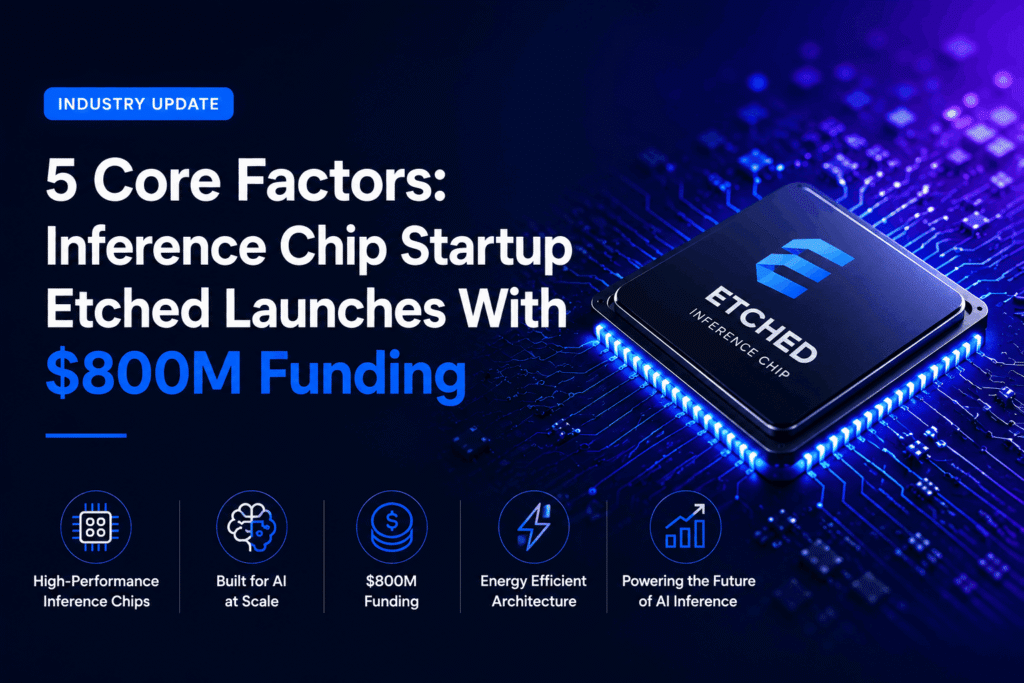
Here’s the headline number: Etched has raised $800 million across several funding rounds, pushing its valuation to $5 billion. A big chunk of that came from a $500 million round led by Stripes.
| Metric | Value |
|---|
| Total Funding Raised | $800 Million (~₹6,680 Crore) |
| Valuation | $5 Billion |
| Forward Booking Pipeline | $1 Billion+ in signed contracts |
| Manufacturing Node | TSMC N4P (advanced 4nm process) |
What really stands out isn’t just the size of the round — it’s that Etched has already locked in over $1 billion in customer commitments before shipping a single chip commercially. In hardware, where products often take years to prove themselves, that kind of pre-launch confidence from paying customers is rare. It tells you hyperscalers and large trading firms are actively looking for alternatives to today’s dominant chip suppliers — and are willing to commit real money to get in line early.
Who’s Backing Etched?
A startup’s investor list often says as much as its product roadmap, and Etched’s is genuinely stacked.
On the institutional side, the round pulled in quant trading giants and VC firms — Jane Street, Hudson River Trading, Two Sigma, and investment vehicles tied to Peter Thiel. These are firms that live and die by latency and execution speed, so their willingness to bet on Etched’s hardware is a meaningful technical vote of confidence, not just a financial one.
Then there’s the personal backing — and this is the part that turns heads. Geoffrey Hinton (widely called the “Godfather of AI”), Fei-Fei Li (the force behind ImageNet and modern computer vision), and Andrej Karpathy (a founding OpenAI member and former Tesla AI lead) have all put their own money and reputations behind the company.
Adding to that, VentureTech Alliance, an investor closely tied to TSMC, gives Etched a real edge when it comes to securing fab capacity — something that’s quietly become one of the biggest constraints in the entire chip industry.
Why a Custom Chip Beats a General-Purpose GPU
The logic behind Etched’s pitch is pretty simple once you break it down: a general-purpose GPU carries a lot of silicon real estate dedicated to jobs it isn’t even doing right now — like graphics rendering or training-specific operations. None of that helps when all you’re doing is running inference on a transformer model.
Etched’s answer is a chip called Sohu, which bakes the transformer’s attention mechanism directly into the hardware itself, instead of routing it through flexible, general-purpose compute paths.
What that gets you, in practice:
- ~10x efficiency gains — no wasted silicon on training-only circuitry, which cuts idle power draw significantly
- Steadier performance under load — a “Low-Voltage Inference” approach keeps clock speeds consistent without overheating
- Full rack-level design — Etched isn’t just shipping a chip; they’re building the cooling, interconnects, and server architecture around it too
The performance numbers back up the pitch: an 8-chip Sohu cluster reportedly processes Meta’s Llama models at up to 500,000 tokens per second, compared to the 25,000–45,000 tokens per second typical of standard data center GPUs doing similar work. That’s not an incremental improvement — that’s a different category of performance entirely.
How They’re Actually Manufacturing This
Designing a chip is one challenge. Actually manufacturing it reliably at scale is a whole different problem — and it’s where most hardware startups stumble.
Etched says it has already hit first-pass (A0) silicon success on TSMC’s N4P node, an enhanced 4-nanometer process that delivers roughly an 11% performance bump over standard 5nm chips, while using less power.
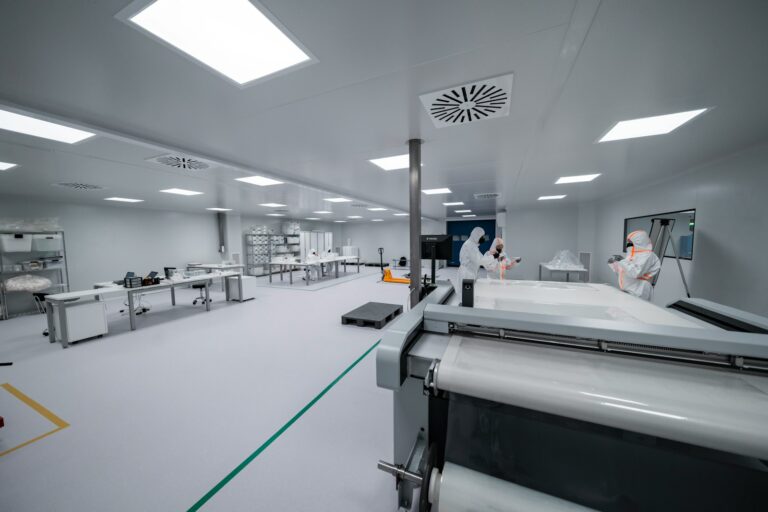
Rather than just designing chips and handing them off to someone else, Etched is building out its own vertical stack — testing facilities, an assembly operation in Taiwan, and a prototyping lab at its San Jose headquarters. The goal is to ship complete, rack-ready systems to customers directly, skipping the slow, fragmented supply chains that typically delay hardware rollouts.
FAQs
Q1: What makes Etched’s chips different from a standard Nvidia GPU? Standard GPUs are built to handle a wide range of jobs — training, graphics, inference, all on the same chip. Etched’s chips are application-specific (ASICs), built only to run transformer model inference. By cutting out everything not needed for that one job, they get major gains in speed and power efficiency.
Q2: Which big names in AI are personally backing Etched? Three of the most recognizable names in the field: Geoffrey Hinton, Fei-Fei Li, and Andrej Karpathy.
Q3: How much has Etched raised, and what’s the company worth? $800 million total, across multiple rounds — including a $500 million round led by Stripes — putting the company’s valuation at $5 billion.
Q4: When can customers expect to get their hands on this hardware? Etched has said it plans to ship its first Sohu systems to validation customers sometime over the summer.
Source: Reporting based on disclosures via SiliconANGLE Media | Bloomberg & Investing Network | GlobeNewswire Disclosures