• English
  • हिन्दी (Hindi)
  • বাংলা (Bengali)
  • தமிழ் (Tamil)
  • తెలుగు (Telugu)
  • मराठी (Marathi)
  • ગુજરાતી (Gujarati)
  • ಕನ್ನಡ (Kannada)
  • മലയാളം (Malayalam)
  • ਪੰਜਾਬੀ (Punjabi)
  • ଓଡ଼ିଆ (Odia)
  • اردو (Urdu)
  • অসমীয়া (Assamese)
  • भोजपुरी (Bhojpuri)
  • मैथिली (Maithili)
  • डोगरी (Dogri)
  • कोंकणी (Konkani)
  • संस्कृत (Sanskrit)
  • سنڌي (Sindhi)
  • नेपाली (Nepali)
  • සිංහල (Sinhala)
  • Español (Spanish)
  • Français (French)
  • Deutsch (German)
  • Italiano (Italian)
  • Português (Portuguese)
  • Русский (Russian)
  • 日本語 (Japanese)
  • 한국어 (Korean)
  • 中文 简体 (Chinese Simplified)
  • 中文 繁體 (Chinese Traditional)
  • العربية (Arabic)
  • עברית (Hebrew)
  • فارسی (Persian)
  • Türkçe (Turkish)
  • Nederlands (Dutch)
  • Svenska (Swedish)
  • Norsk (Norwegian)
  • Dansk (Danish)
  • Suomi (Finnish)
  • Polski (Polish)
  • Čeština (Czech)
  • Slovenčina (Slovak)
  • Slovenščina (Slovenian)
  • Magyar (Hungarian)
  • Română (Romanian)
  • Български (Bulgarian)
  • Українська (Ukrainian)
  • Ελληνικά (Greek)
  • Hrvatski (Croatian)
  • Српски (Serbian)
  • ไทย (Thai)
  • Tiếng Việt (Vietnamese)
  • Bahasa Indonesia (Indonesian)
  • Bahasa Melayu (Malay)
  • Filipino
  • မြန်မာ (Burmese)
  • ខ្មែរ (Khmer)
  • ລາວ (Lao)
  • Монгол (Mongolian)
  • Қазақ (Kazakh)
  • Oʻzbek (Uzbek)
  • Кыргызча (Kyrgyz)
  • Тоҷикӣ (Tajik)
  • Türkmen (Turkmen)
  • Azərbaycan (Azerbaijani)
  • Հայերեն (Armenian)
  • ქართული (Georgian)
  • Беларуская (Belarusian)
  • Lietuvių (Lithuanian)
  • Latviešu (Latvian)
  • Eesti (Estonian)
  • Íslenska (Icelandic)
  • Gaeilge (Irish)
  • Gàidhlig (Scots Gaelic)
  • Cymraeg (Welsh)
  • Euskara (Basque)
  • Català (Catalan)
  • Galego (Galician)
  • Malti (Maltese)
  • Македонски (Macedonian)
  • Bosanski (Bosnian)
  • Shqip (Albanian)
  • Afrikaans
  • Kiswahili (Swahili)
  • አማርኛ (Amharic)
  • Hausa
  • Igbo
  • Yorùbá (Yoruba)
  • isiZulu (Zulu)
  • isiXhosa (Xhosa)
  • Sesotho
  • Sepedi
  • Shona
  • Soomaali (Somali)
  • Kinyarwanda
  • Chichewa
  • ትግርኛ (Tigrinya)
  • Oromoo (Oromo)
  • Xitsonga (Tsonga)
  • Luganda
  • Akan (Twi)
  • Lëtzebuergesch (Luxembourgish)
  • Frysk (Frisian)
  • Corsu (Corsican)
  • Esperanto
  • Latina (Latin)
  • Basa Jawa (Javanese)
  • Basa Sunda (Sundanese)
  • Cebuano
  • ʻŌlelo Hawaiʻi (Hawaiian)
  • Gagana Samoa (Samoan)
  • Te Reo Māori (Maori)
  • Kreyòl Ayisyen (Haitian Creole)
  • Runasimi (Quechua)
  • Aymar Aru (Aymara)
  • Avañeʼẽ (Guarani)
  • Kurdî (Kurdish)
  • کوردیی ناوەندی (Kurdish Sorani)
  • پښتو (Pashto)
  • ئۇيغۇرچە (Uyghur)
  • ދިވެހި (Dhivehi)
  • ייִדיש (Yiddish)
  • Krio
  • Mizo
  • Manipuri (Meiteilon)
  • Eʋegbe (Ewe)
  • Lingála
  • Bamanankan (Bambara)
  • Hmoob (Hmong)
  • Ilokano

Why Cybersecurity Is Important for Small Businesses to Large Enterprises

Why Cybersecurity Is Important for Small Businesses to Enterprises.

Gagan Saxena

Writer & Blogger

Gagan Saxena

Managing Editor

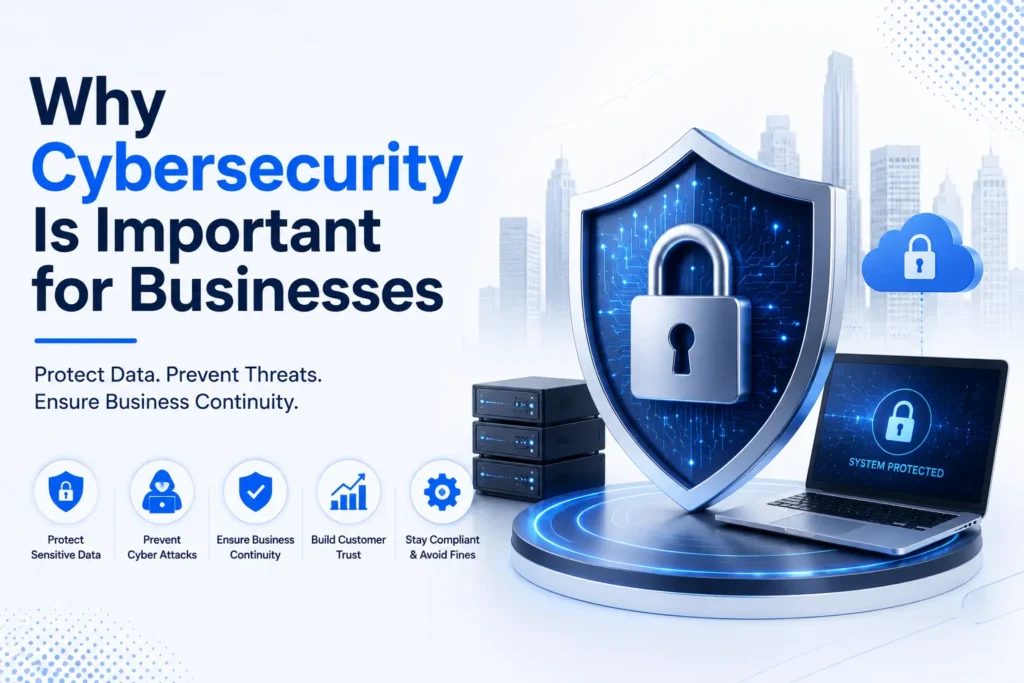
From startups to global enterprises, cybersecurity is now a business foundation. Here’s why it matters and how companies can strengthen it.

Why Cybersecurity Is Important for Businesses
Previous Post
Next Post

Cybersecurity Isn’t Just an IT Job Anymore

There was a time when cybersecurity sat quietly in the IT department, treated as a technical checkbox rather than a business priority. That time is over. Today, it’s a foundation every successful business is built on — whether that’s a five-person startup or a global enterprise with offices across continents.

Think about how much of a business now runs through digital systems: cloud platforms, online payments, customer databases, internal communication tools. Nearly everything touches the internet in some way. And as that dependency has grown, so has the threat landscape — ransomware, phishing, data breaches, and increasingly, AI-powered attacks that are faster and harder to detect than anything security teams dealt with a few years ago.

The stakes are simple to state and hard to overstate: one security weakness, exploited at the wrong time, can disrupt operations, damage customer trust, and hurt a company’s reputation in ways that take years to rebuild.

What Is Cybersecurity, Really?

At its core, cybersecurity is the practice of protecting computer systems, networks, applications, and data from unauthorized access and digital attacks. It’s not one single tool or product — it’s a combination of technologies and processes working together, including:

  • Network security
  • Data protection
  • Cloud security
  • Multi-factor authentication (MFA)
  • Employee security awareness
  • Continuous threat monitoring

None of these work well in isolation. Real protection comes from layering them — technology alone doesn’t stop breaches if employees aren’t trained to spot a phishing email, and awareness alone doesn’t help if the underlying systems are outdated and unpatched.

Why Small Businesses Can’t Afford to Skip It

A common — and dangerous — assumption among small business owners is that hackers only go after big corporations. In reality, small businesses are often more attractive targets, precisely because they tend to have fewer security resources and weaker defenses in place.

For a small or growing business, cybersecurity does more than just prevent bad outcomes — it actively supports growth by helping:

  • Protect customer information
  • Prevent financial losses from fraud or downtime
  • Keep websites and systems running without interruption
  • Secure business email from compromise
  • Build the kind of trust that keeps customers coming back

The mindset shift that matters here: cybersecurity isn’t an expense to minimize. It’s an investment in the business’s long-term stability — the same way insurance or accounting is treated as essential infrastructure, not optional overhead.

Why Large Enterprises Pour Millions Into It

At enterprise scale, the numbers change dramatically — and so does the risk. Large companies manage massive volumes of customer, employee, and financial data, and a single successful attack can affect millions of users while bringing core operations to a halt.

That’s why large enterprises invest heavily in cybersecurity to:

  • Protect sensitive business data across every department
  • Prevent ransomware attacks before they can spread
  • Secure sprawling cloud infrastructure
  • Stay compliant with evolving security regulations
  • Protect brand reputation, which can take a serious hit after even one public breach

For enterprises, cybersecurity spending isn’t reactive — it’s baked into how the business operates, because the cost of a breach is almost always higher than the cost of prevention.

The Cyber Threats Every Business Should Know

Regardless of company size, most cyberattacks fall into a handful of recognizable categories:

1. Phishing Attacks Fake emails or messages designed to trick employees into handing over passwords or financial information. These have gotten more convincing over time, often mimicking real colleagues or trusted vendors.

2. Ransomware Attackers lock a company’s data and demand payment to release it — often bringing operations to a complete standstill until it’s resolved.

3. Data Breaches Private customer or company information gets stolen, sometimes sitting undetected for weeks or months before it’s discovered.

4. Malware Attacks Harmful software designed to damage systems or quietly steal information in the background.

5. Weak Password Attacks Hackers use stolen or easily guessed login credentials to walk straight into business systems — one of the simplest, and still most common, points of entry.

How Companies Can Actually Improve Their Security

The good news: most of the fundamentals aren’t complicated or expensive. Businesses can meaningfully reduce their risk by consistently following a few core practices:

  • Use strong passwords paired with multi-factor authentication
  • Keep software updated rather than delaying patches
  • Back up important data regularly, and test that backups actually work
  • Train employees to recognize phishing and other common threats
  • Use antivirus and firewall protection as a baseline, not an afterthought
  • Monitor systems continuously instead of waiting for something to go wrong

None of these individually guarantee safety — but together, they close most of the doors attackers rely on.

Where Cybersecurity Is Headed Next

As artificial intelligence, cloud computing, and digital transformation continue accelerating, cybersecurity is only going to matter more, not less. The businesses of tomorrow won’t just be competing on products and pricing — they’ll be competing on how well they protect the technology their entire operation runs on.

Companies that treat cybersecurity as a priority today are the ones building safer, more resilient, and more trusted businesses for the future. The ones that delay it usually end up paying far more later — in downtime, lost trust, or a breach that could have been prevented.

Conclusion

Cybersecurity isn’t optional anymore — not for a 10-person startup, and not for a 100,000-employee enterprise. Protecting digital assets, customer trust, and day-to-day operations has become a core part of what it means to run a successful business in today’s digital economy.

Stay updated with FindBrief for the latest insights on technology, cybersecurity, AI, and where these industries are headed next.


FAQs


Small businesses are frequent targets precisely because they often have weaker security defenses. Strong cybersecurity protects customer data, prevents financial losses, and builds the trust needed to grow.

Yes — enterprises manage enormous volumes of sensitive data, and a single breach can affect millions of users while halting operations, making strong security an operational necessity, not a luxury.

Phishing attacks, ransomware, data breaches, malware, and weak password exploits remain the most common threats across businesses of every size.

Strong passwords with multi-factor authentication, regular software updates, consistent data backups, employee training, and continuous system monitoring form a solid baseline for any business.

Yes — as AI, cloud computing, and digital transformation continue to grow, protecting digital infrastructure will become just as important as building it.


Leave a Reply

Your email address will not be published. Required fields are marked *

Previous Post
Next Post

Subscribe to Our Newsletter

    © 2026 FindBrief. All Rights Reserved.

    Which language are you reading?

    Apni pasandida bhasha chunein

    • English
    • हिन्दी (Hindi)
    • বাংলা (Bengali)
    • தமிழ் (Tamil)
    • తెలుగు (Telugu)
    • मराठी (Marathi)
    • ગુજરાતી (Gujarati)
    • ಕನ್ನಡ (Kannada)
    • മലയാളം (Malayalam)
    • ਪੰਜਾਬੀ (Punjabi)
    • ଓଡ଼ିଆ (Odia)
    • اردو (Urdu)
    • অসমীয়া (Assamese)
    • भोजपुरी (Bhojpuri)
    • मैथिली (Maithili)
    • डोगरी (Dogri)
    • कोंकणी (Konkani)
    • संस्कृत (Sanskrit)
    • سنڌي (Sindhi)
    • नेपाली (Nepali)
    • සිංහල (Sinhala)
    • Español (Spanish)
    • Français (French)
    • Deutsch (German)
    • Italiano (Italian)
    • Português (Portuguese)
    • Русский (Russian)
    • 日本語 (Japanese)
    • 한국어 (Korean)
    • 中文 简体 (Chinese Simplified)
    • 中文 繁體 (Chinese Traditional)
    • العربية (Arabic)
    • עברית (Hebrew)
    • فارسی (Persian)
    • Türkçe (Turkish)
    • Nederlands (Dutch)
    • Svenska (Swedish)
    • Norsk (Norwegian)
    • Dansk (Danish)
    • Suomi (Finnish)
    • Polski (Polish)
    • Čeština (Czech)
    • Slovenčina (Slovak)
    • Slovenščina (Slovenian)
    • Magyar (Hungarian)
    • Română (Romanian)
    • Български (Bulgarian)
    • Українська (Ukrainian)
    • Ελληνικά (Greek)
    • Hrvatski (Croatian)
    • Српски (Serbian)
    • ไทย (Thai)
    • Tiếng Việt (Vietnamese)
    • Bahasa Indonesia (Indonesian)
    • Bahasa Melayu (Malay)
    • Filipino
    • မြန်မာ (Burmese)
    • ខ្មែរ (Khmer)
    • ລາວ (Lao)
    • Монгол (Mongolian)
    • Қазақ (Kazakh)
    • Oʻzbek (Uzbek)
    • Кыргызча (Kyrgyz)
    • Тоҷикӣ (Tajik)
    • Türkmen (Turkmen)
    • Azərbaycan (Azerbaijani)
    • Հայերեն (Armenian)
    • ქართული (Georgian)
    • Беларуская (Belarusian)
    • Lietuvių (Lithuanian)
    • Latviešu (Latvian)
    • Eesti (Estonian)
    • Íslenska (Icelandic)
    • Gaeilge (Irish)
    • Gàidhlig (Scots Gaelic)
    • Cymraeg (Welsh)
    • Euskara (Basque)
    • Català (Catalan)
    • Galego (Galician)
    • Malti (Maltese)
    • Македонски (Macedonian)
    • Bosanski (Bosnian)
    • Shqip (Albanian)
    • Afrikaans
    • Kiswahili (Swahili)
    • አማርኛ (Amharic)
    • Hausa
    • Igbo
    • Yorùbá (Yoruba)
    • isiZulu (Zulu)
    • isiXhosa (Xhosa)
    • Sesotho
    • Sepedi
    • Shona
    • Soomaali (Somali)
    • Kinyarwanda
    • Chichewa
    • ትግርኛ (Tigrinya)
    • Oromoo (Oromo)
    • Xitsonga (Tsonga)
    • Luganda
    • Akan (Twi)
    • Lëtzebuergesch (Luxembourgish)
    • Frysk (Frisian)
    • Corsu (Corsican)
    • Esperanto
    • Latina (Latin)
    • Basa Jawa (Javanese)
    • Basa Sunda (Sundanese)
    • Cebuano
    • ʻŌlelo Hawaiʻi (Hawaiian)
    • Gagana Samoa (Samoan)
    • Te Reo Māori (Maori)
    • Kreyòl Ayisyen (Haitian Creole)
    • Runasimi (Quechua)
    • Aymar Aru (Aymara)
    • Avañeʼẽ (Guarani)
    • Kurdî (Kurdish)
    • کوردیی ناوەندی (Kurdish Sorani)
    • پښتو (Pashto)
    • ئۇيغۇرچە (Uyghur)
    • ދިވެހި (Dhivehi)
    • ייִדיש (Yiddish)
    • Krio
    • Mizo
    • Manipuri (Meiteilon)
    • Eʋegbe (Ewe)
    • Lingála
    • Bamanankan (Bambara)
    • Hmoob (Hmong)
    • Ilokano
    Scroll to Top